

Introduction
The image of the virile, bald man has long been embedded in popular culture, leading many to wonder whether there’s a genuine connection between high sex drive and baldness. This enduring stereotype suggests that men with increased libido are more likely to experience hair loss, often attributed to supposedly elevated levels of high testosterone. But does science actually support this widely held belief?
Whilst it’s true that hormones play a crucial role in male pattern baldness, the relationship between sexual virility and hair loss is far more complex than commonly portrayed. Androgenetic alopecia, the medical term for pattern hair loss, affects millions of men worldwide, yet the mechanisms behind it are often misunderstood. The assumption that bald men possess heightened sexual prowess stems from oversimplified interpretations of how hormones influence both hair growth and sexual function.
This article delves into the scientific evidence surrounding testosterone’s actual role in hair loss, examining how it converts to other compounds that directly affect hair follicles. We’ll explore why the primary culprit behind balding isn’t testosterone itself, but rather a specific derivative that impacts genetically susceptible individuals. Additionally, we’ll address the persistent myths linking baldness to virility, revealing what research actually shows about sexual health in men experiencing hair loss.
Beyond hormones, we’ll investigate the various genetic and lifestyle factors that contribute to hair loss patterns. Finally, we’ll review current treatment approaches and preventive strategies available for those concerned about maintaining their hair whilst addressing any misconceptions about their impact on sexual health.
Key Takeaways – TL/DR
- High sex drive itself doesn’t directly cause baldness – the relationship is more complex involving genetics and hormone sensitivity
- DHT (dihydrotestosterone), not testosterone levels alone, is the primary hormone responsible for male pattern hair loss
- Many bald men have normal or even low testosterone levels, debunking the virility-baldness myth
- Genetic predisposition and androgen receptor sensitivity are the main factors determining hair loss risk
The Science Behind Testosterone and Hair Loss
The relationship between sex hormones and hair follicles involves complex biological mechanisms that go beyond simple testosterone levels. Understanding how testosterone converts to its more potent form and how hair follicles respond to these hormones explains why increased libido doesn’t directly correlate with baldness.
How Testosterone Converts to DHT
The enzyme 5-alpha reductase catalyses the conversion of testosterone into dihydrotestosterone (DHT), a process that varies significantly across different tissues. In scalp tissue, approximately 5-7% of circulating testosterone undergoes this conversion[1], whilst genital skin demonstrates considerably higher enzymatic activity. This tissue-specific variation explains why some men maintain healthy scalp hair despite having high testosterone levels. The hair growth cycle becomes disrupted when DHT binds to androgen receptors in susceptible follicles, causing them to miniaturise progressively. However, the mere presence of high DHT levels doesn’t guarantee hair loss – receptor sensitivity plays an equally crucial role.
Androgen Receptor Sensitivity
Genetic variations in androgen receptors determine individual susceptibility to male pattern baldness far more than absolute hormone levels. Research has identified specific polymorphisms in the androgen receptor gene that increase follicle sensitivity to DHT[2]. These inherited variations explain why some men with normal testosterone levels experience significant hair loss whilst others with elevated levels maintain full heads of hair. Receptor density also varies between scalp regions, with crown and frontal areas typically showing higher concentrations than occipital regions, accounting for characteristic balding patterns.

Understanding DHT: The Real Culprit Behind Male Pattern Baldness
Dihydrotestosterone (DHT), rather than testosterone itself, stands as the primary hormonal trigger for male pattern hair loss. This potent androgen forms when testosterone encounters the enzyme 5-alpha reductase, creating a hormone five times more powerful than its precursor. Research demonstrates that men experiencing androgenic alopecia typically show higher DHT levels in their scalp tissue compared to non-balding individuals, despite often having similar testosterone concentrations [3].
DHT’s destructive impact on hair follicles occurs through a process called miniaturisation. When DHT binds to androgen receptors in genetically susceptible follicles, it progressively shrinks them, causing gradual thinning until hair production ceases entirely. Interestingly, DHT plays essential roles during male development, particularly in fetal genital formation and secondary sexual characteristics [4], explaining why complete DHT suppression isn’t medically advisable.
The distinction between testosterone and DHT proves crucial for understanding hair loss patterns. Whilst testosterone levels might remain normal or even low, localised DHT production in the scalp determines balding progression. This explains why some men with average testosterone experience significant hair loss, whilst others with higher levels maintain full heads of hair—genetic sensitivity to DHT matters more than absolute hormone concentrations.
Debunking the High Sex Drive and Baldness Myth
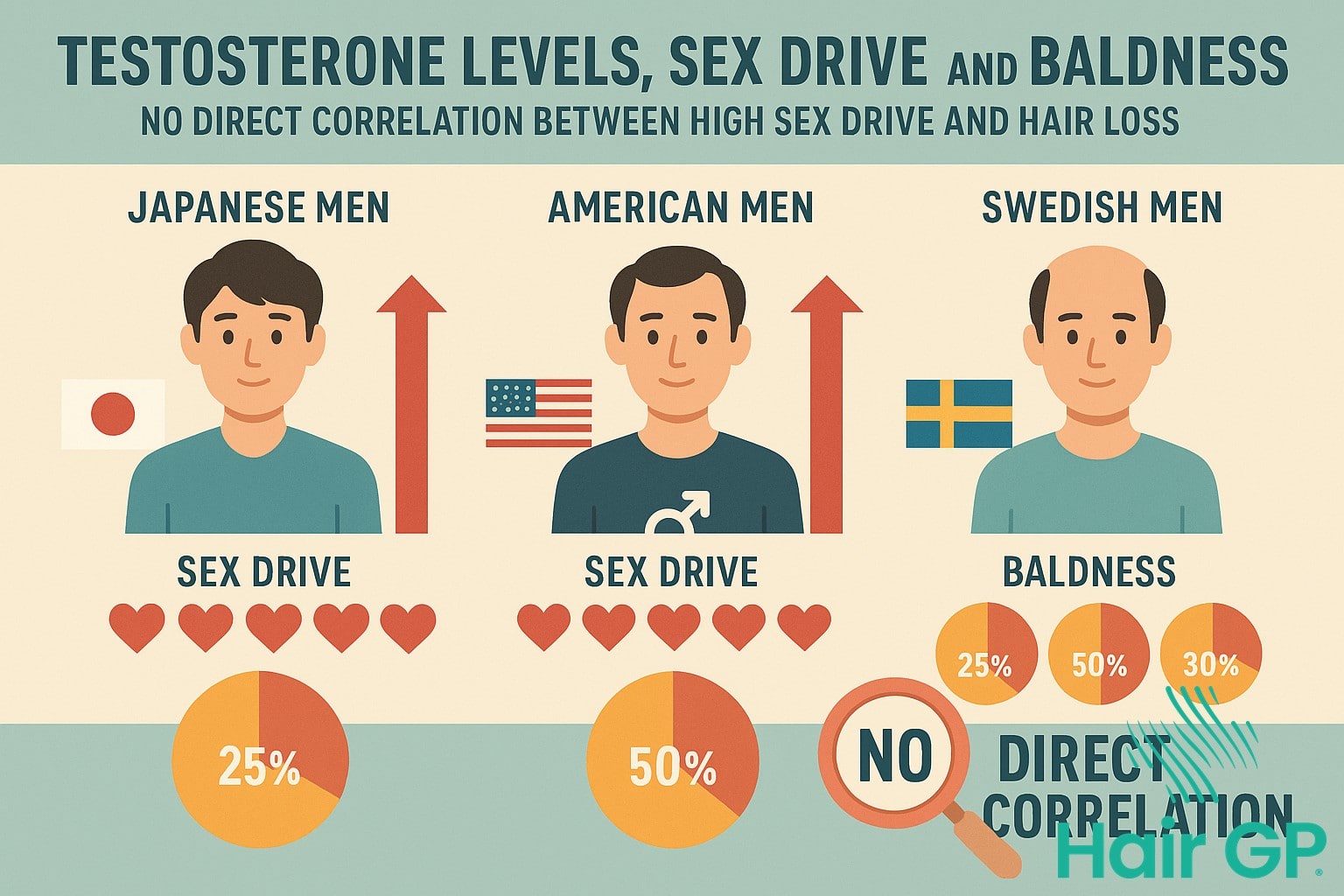
The persistent stereotype linking baldness with heightened virility lacks scientific support, despite widespread cultural beliefs. Research consistently demonstrates that bald men possess no inherent advantages in sexual performance or hormone levels compared to their non-balding counterparts.
Research on Testosterone Levels in Bald Men
Comprehensive population studies reveal that testosterone levels remain remarkably consistent across balding and non-balding men. A large-scale analysis found no significant difference in serum testosterone concentrations between men with androgenetic alopecia and controls [5]. Most men, regardless of hair status, maintain testosterone levels within normal ranges of 300-1000 ng/dL. Contrary to popular belief, some studies actually indicate that men with early-onset baldness may experience low testosterone later in life, challenging the notion that baldness signals hormonal vigour.
Sexual Health and Hair Loss: What Studies Show
Research examining sexual health in balding men reveals no correlation between hair loss and enhanced sexual function. Studies investigating erectile dysfunction prevalence show similar rates among balding and non-balding populations [6]. Libido measurements remain consistent across both groups, with psychological factors rather than hormonal differences accounting for any variations in sexual confidence. The perception of being more virile appears rooted in cultural mythology rather than biological reality, with scientific evidence consistently debunking this enduring misconception.
Risk Factors for Male Pattern Baldness Beyond Hormones
Whilst hormones play a crucial role in male pattern baldness, numerous other risk factors contribute to hair loss development. Understanding these additional elements helps explain why some individuals experience extensive hair thinning whilst others maintain full hairlines despite similar hormone levels.
Genetic Predisposition
Family history remains the strongest predictor of pattern baldness beyond hormonal influence. Both maternal and paternal genetics contribute, with studies suggesting the X chromosome carries significant baldness-related genes. Multiple genetic variations interact to determine susceptibility, affecting everything from androgen receptor sensitivity to hair follicle miniaturisation rates. Early onset indicators often appear when multiple risk genes combine, sometimes causing noticeable hairline recession before age 20.
Age and Other Health Factors
Age amplifies hair loss risk, with approximately 50% of men experiencing some degree of balding by age 50. Puberty onset patterns establish baseline susceptibility, as earlier puberty correlates with increased baldness risk. Various health conditions compound these effects—chronic stress can trigger telogen effluvium, whilst autoimmune disorders may cause alopecia areata. Nutritional deficiencies, particularly in iron, vitamin D, and B-complex vitamins, accelerate hair thinning. Additionally, thyroid dysfunction, scalp infections, and certain medications can exacerbate genetic predisposition to hair loss.
Treatment Options and Prevention Strategies
Several evidence-based treatment options exist for those seeking to prevent hair loss and stimulate hair growth. FDA-approved medications demonstrate significant success in clinical trials, whilst lifestyle modifications provide complementary support for maintaining healthy hair.
FDA-Approved Medications
Finasteride, a selective DHT blocker, leads pharmaceutical interventions for male pattern baldness. Clinical trials demonstrate that 1mg daily finasteride prevents further hair loss in 86% of men and promotes regrowth in 65% after two years [7]. Minoxidil, available as topical solution, stimulates follicular activity through enhanced blood flow. Studies show 5% minoxidil twice daily produces visible hair growth in 60% of users within 16 weeks [8]. Side effect profiles remain generally mild, though finasteride may affect sexual function in 2-4% of users. Unlike scalp hair, body hair typically remains unaffected by these treatments.
Lifestyle and Natural Approaches
Stress reduction through meditation and regular exercise supports optimal hair health by regulating cortisol levels. Nutritional support, particularly adequate protein, iron, and B-vitamins, provides essential building blocks for hair growth. Scalp care practices including gentle massage and avoiding harsh chemicals help maintain follicular health and complement medical treatment strategies.
Conclusion
The myth that increased libido or sexual activity directly causes male hair loss lacks scientific foundation. Whilst high testosterone levels and other androgens play roles in both sexual function and hair follicle health, the relationship proves far more nuanced than popular belief suggests. Men experiencing robust sexual desire needn’t fear their penis activity will precipitate baldness – the mechanisms governing these processes remain distinctly separate.
Pattern baldness results from a complex interplay of genetic predisposition, follicular sensitivity to DHT, and environmental factors rather than sexual behaviour or libido levels. Interestingly, men with more testosterone often display increased facial hair growth whilst simultaneously experiencing scalp hair thinning – demonstrating the tissue-specific nature of androgen responses. This paradox underscores why simplistic assumptions about hormones and hair loss prove misleading.
Those concerned about hair loss should pursue evidence-based treatments rather than altering their sexual habits. Consulting qualified healthcare professionals ensures appropriate interventions targeting the actual mechanisms of follicular miniaturisation. Understanding that sexual health and scalp health operate through different pathways empowers men to address hair loss concerns without unnecessary anxiety about their intimate lives. Science continues advancing our comprehension of these intricate biological processes, offering hope for more effective treatments.
Frequently Asked Questions
No, research shows that bald men don’t necessarily have higher testosterone levels than men with full hair. Male pattern baldness is primarily caused by genetic sensitivity to DHT (dihydrotestosterone), not high testosterone levels. Many balding men have normal or even low testosterone.
There is no scientific evidence linking sexual activity frequency to hair loss. This myth likely stems from misconceptions about testosterone and DHT. Sexual activity doesn’t significantly affect hormone levels in a way that would influence male pattern baldness.
Low sex drive and future baldness are not directly connected. While both can be influenced by hormones, they operate through different mechanisms. Low libido might indicate low testosterone, which actually doesn’t cause baldness. Hair loss risk is determined primarily by genetics and DHT sensitivity.
Some hair loss treatments, particularly finasteride (which blocks DHT production), can potentially affect sexual function in a small percentage of users. Side effects may include decreased libido or erectile dysfunction, though these are typically reversible upon discontinuation. Minoxidil doesn’t affect sexual function.
References
- Azzouni F, Godoy A, Li Y, Mohler J. The 5 alpha-reductase isozyme family: a review of basic biology and their role in human diseases. Adv Urol. 2012. PMID: 22235201
- Inui S, Itami S. Androgen actions on the human hair follicle: perspectives. Exp Dermatol. 2013. PMID: 23016593
- Dallob AL, Sadick NS, Unger W, Lipert S, Geissler LA, Gregoire SL et al.. The effect of finasteride, a 5 alpha-reductase inhibitor, on scalp skin testosterone and dihydrotestosterone concentrations in patients with male pattern baldness. J Clin Endocrinol Metab. 1994. PMID: 8077349
- Imperato-McGinley J. 5alpha-reductase-2 deficiency and complete androgen insensitivity: lessons from nature. Adv Exp Med Biol. 2002. PMID: 12575759
- Urysiak-Czubatka I, Kmieć ML, Broniarczyk-Dyła G. Assessment of the usefulness of dihydrotestosterone in the diagnostics of patients with androgenetic alopecia. Postepy Dermatol Alergol. 2014. PMID: 25254005
- Gasques L, Lima A, Lima M, Tosti A, Silva M, Barletta M. Dutasteride Infusion in Male Androgenetic Alopecia Using a Novel Drug Delivery Technique: MMP Skin Appendage Disord. 2025. PMID: 41064071
- Kaufman KD, Olsen EA, Whiting D, et al. Finasteride in the treatment of men with androgenetic alopecia. J Am Acad Dermatol. 1998;39(4):578-589. PMID: 9777765
- Olsen EA, Dunlap FE, Funicella T, et al. A randomized clinical trial of 5% topical minoxidil versus 2% topical minoxidil and placebo in the treatment of androgenetic alopecia in men. J Am Acad Dermatol. 2002;47(3):377-385. PMID: 12196747