








Hair Conditions
Hair loss is not one condition. It’s a symptom with dozens of possible causes, and the treatment that works for one type can be completely wrong for another. That’s why diagnosis comes before treatment at Hair GP — because getting the answer right determines everything that follows.
Below you’ll find the conditions we diagnose and treat most frequently. Each page explains what the condition is, how to recognise it, and what treatment options exist. If you’re unsure which applies to you, a specialist consultation with trichoscopic assessment will give you a clear answer.
Hormonal & Genetic Hair Loss
These conditions are driven by hormonal changes, genetic predisposition, or both. They’re the most common causes of hair loss in women — and the most treatable when diagnosed correctly.

IVF & Fertility Treatment
Shedding during or after IVF is real — oestrogen swings on a two-to-three month delay. What it means, and what is safe to do while you are trying to conceive.

Female Pattern Hair Loss
The most common cause of hair thinning in women, affecting up to 40% by age 50. Genetic, progressive, and highly treatable — especially when caught early.

Menopause Hair Loss
Over half of women experience hair changes at menopause. Declining oestrogen shifts the hormonal balance toward androgens, triggering thinning that’s often mistaken for ageing. Treatment options exist beyond HRT — and HRT alone rarely resolves it.
Perimenopause Hair Loss
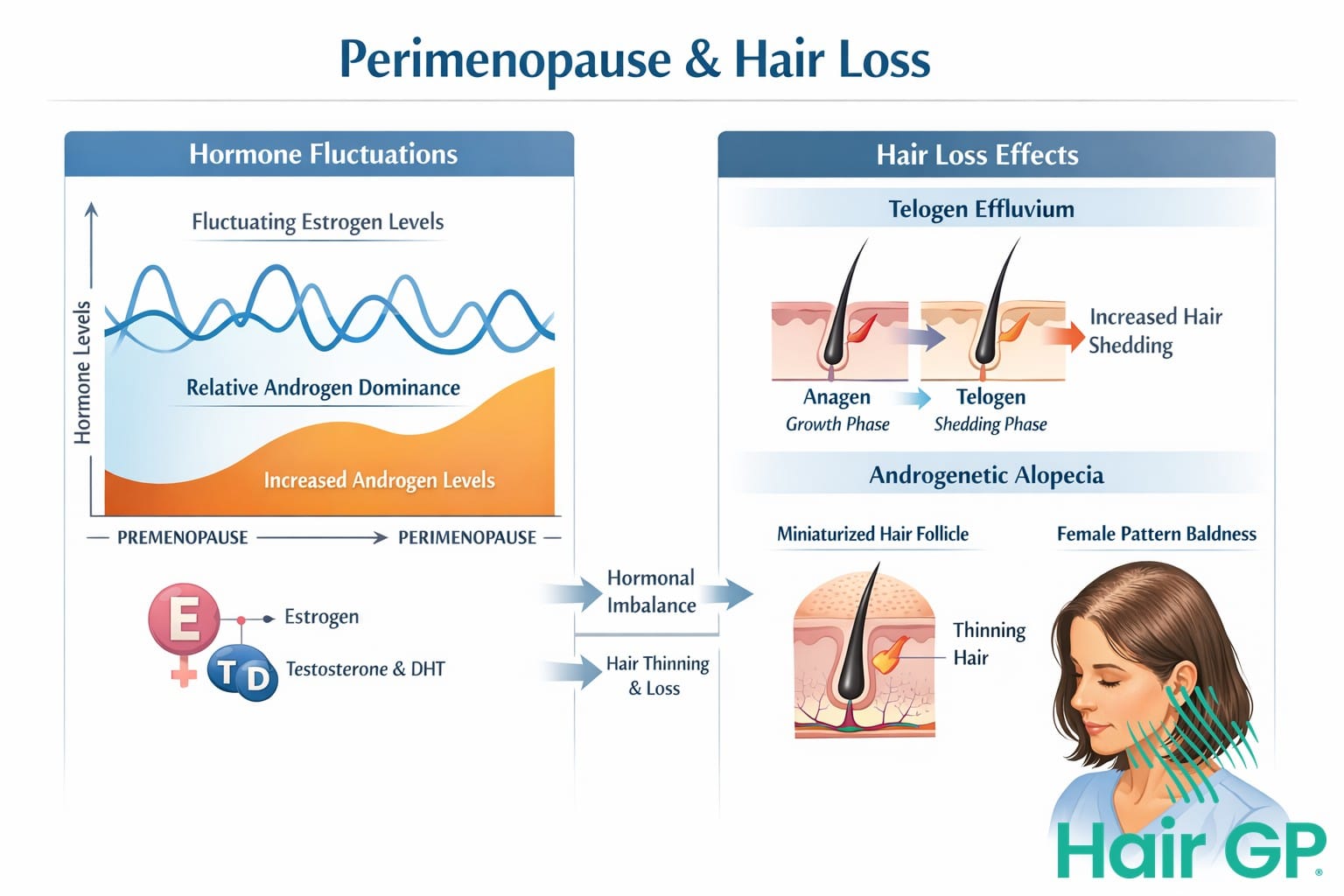
Hair loss can begin years before menopause — during the hormonal fluctuations of perimenopause. It’s frequently missed because periods haven’t stopped yet and GP blood tests may still look “normal.”

PCOS Hair Loss
PCOS-related hair loss is driven by excess androgens — the same hormones that cause acne and facial hair growth. Up to 30% of women with PCOS experience scalp thinning. Treatment targets the hormonal cause, not just the symptom.

HRT and Hair Loss
Started HRT and shedding more — or hoping HRT will fix your thinning? Both stories are real, and the difference usually comes down to formulation: some progestogens quietly work against your hair while the right regimen supports it. What to check before you blame the dose.

Postpartum Hair Loss
Up to 90% of new mothers experience hair shedding after giving birth. It’s usually temporary — but when it doesn’t resolve by 12 months, underlying female pattern hair loss may have been unmasked by the hormonal shift.
Reactive & Temporary Hair Loss
These conditions involve sudden shedding triggered by a specific event or stressor. They’re usually reversible — but accurate diagnosis matters because they can co-exist with progressive conditions.

Telogen Effluvium
The most common cause of sudden, diffuse hair shedding. A trigger — illness, surgery, medication, hormonal change — pushes follicles into their resting phase prematurely. Temporary in most cases, but chronic TE lasting beyond six months needs investigation.

Hair Falling Out in Clumps
Noticing large amounts of hair in your brush or bathroom drain can be alarming, but understanding the underlying causes can help you take effective steps toward hair health and confidence.

Stress Hair Loss
Hair falling out after a stressful event? Stress triggers sudden shedding that usually recovers — but diagnosis determines whether it’s temporary or signals something more. Not all stress-related thinning behaves the same way.

Medication-Induced Hair Loss
Started a new medicine two or three months before the shedding began? That lag is the classic signature. Lamotrigine, antidepressants, beta-blockers, retinoids and more — which drugs shed hair, and what to do about it without stopping your treatment.
Autoimmune & Inflammatory Hair Loss
Autoimmune conditions cause the body’s immune system to attack hair follicles directly. The pattern and behaviour are distinct from hormonal hair loss, and treatment requires a different approach.

Alopecia Areata
An autoimmune condition causing sudden patchy hair loss. Can affect women at any age and responds well to early treatment.

Frontal Fibrosing Alopecia
A scarring condition causing progressive hairline recession and eyebrow loss. Early diagnosis halts progression — but hair can’t regrow where scarring has already occurred. Often confused with traction alopecia, which requires completely different treatment.
Mechanical Hair Loss
Hair loss caused by physical force or damage to the follicle rather than hormones or the immune system. Preventable — and often reversible with early intervention.

Traction Alopecia
Hair loss from repeated tension on follicles — from braids, ponytails, extensions, or tight styling. Preventable and reversible when caught early, but can become permanent if the cause continues.
Afro Hair Loss in Black Women
Traction alopecia and CCCA dominate Black women’s hair loss — one fully reversible if caught early, one permanent if left to spread. Edges, crown thinning and the causes nobody tests for, examined properly and without the styling lecture.
Medical & Systemic
These conditions cause hair loss as a consequence of an underlying medical issue. Treating the hair without addressing the root cause won’t work.

Thyroid Hair Loss
Thyroid disorders cause diffuse thinning and texture changes — and hair loss is often the first symptom noticed. Even women on thyroid medication can continue losing hair if their levels aren’t optimised for hair health, not just “within range.”

Iron Deficiency Hair Loss
Low iron is one of the most common — and most fixable — causes of hair loss in women. But your ferritin can be “normal” by GP standards and still too low for your hair. The threshold matters, and most GPs use the wrong one.

Scarring Alopecia
Scarring alopecia destroys hair follicles permanently — but early treatment can halt the damage and preserve your hair. Learn how to recognise the warning signs, understand the different types affecting women, and find out why specialist diagnosis matters.
Hair Loss from Medications & Weight Loss.
Hair loss triggered by weight loss medications like Ozempic, Wegovy, and Mounjaro. Usually temporary — but rapid weight loss can also unmask underlying conditions that won’t resolve on their own.

Ozempic Hair Loss
Losing hair on Ozempic? GLP-1 weight loss medications can trigger temporary shedding — but for some women, the picture is more complex than simple telogen effluvium.

Wegovy Hair Loss
Hair thinning on Wegovy? At 2.4mg weekly, Wegovy’s higher semaglutide dose means faster weight loss — and a greater risk of hair shedding. But for some women, it’s not just temporary.

Mounjaro Hair Loss
Hair thinning on Wegovy? At 2.4mg weekly, Wegovy’s higher semaglutide dose means faster weight loss — and a greater risk of hair shedding. But for some women, it’s not just temporary.
Hair Loss By Symptom
What Does Your Hair Loss Look Like?
Many women search by what they can see — not by a diagnosis they don’t have yet. If one of these matches what you’re noticing, start here.

Receding Hairline
A widening parting or thinning crown is the most common pattern of hair loss in women — and one of the most treatable when caught early

Not sure where to start? Ask the clinic first.
Dr Amy Vowler · GMC-registered GP · GMC 7451097
Message us on WhatsApp or give us a ring. We can't give clinical advice over a message, but we can tell you how the consultation works, what it costs and whether Dr Amy is the right person for you. No obligation, nothing to prepare.
Not from symptoms alone — many types look identical in the mirror, and two often overlap (pattern loss plus a heavy shed, for example). A trichoscopic examination and, where needed, blood tests separate them in a single appointment, and that diagnosis is what makes treatment work.
Yes — in clinic it’s the rule rather than the exception. A menopausal shift, low iron and pattern loss frequently arrive together, and treating only one of them is the usual reason progress stalls. That’s why we examine before we prescribe.
Anything driven by a trigger — telogen effluvium, low iron, thyroid shifts — usually recovers well once the cause is corrected. Pattern hair loss can’t be cured but responds well to ongoing treatment. Scarring alopecias are the urgent group: caught early, further loss can be prevented, so scalp symptoms alongside shedding deserve prompt assessment.
Not Sure Which Type You Have?
Many women have more than one type of hair loss at the same time — and that’s precisely why self-diagnosis is unreliable. A specialist consultation with trichoscopic assessment identifies exactly what’s happening, whether one condition or several are contributing, and what treatment will actually work.
Every consultation at Hair GP is with a female doctor who specialises in hair loss in women.
Understand what's causing your hair loss
A 50-minute consultation with Dr Amy includes scalp microscopy, and a personalised treatment plan—giving you definitive answers rather than continued guessing.
Book Your Hair Loss Assessment£300 consultation | Parsons Green, London
Next-day appointments often available