











Finding handfuls of hair in the shower, on your pillow, and tangled around your fingers is one of the more alarming parts of early motherhood that nobody warns you about. If this is happening to you, you’re far from alone. Postpartum hair loss affects up to 90% of new mothers to some degree — it’s driven by the dramatic drop in oestrogen after birth, and for most women, it’s temporary, resolving within 6–12 months.
But not always. When shedding persists beyond that window, or when hair doesn’t recover between pregnancies, something more than normal postpartum shedding may be going on. At Hair GP, our female doctor-led clinic in London specialises in women’s hair loss at every life stage — including the hormonal upheaval that comes with pregnancy and beyond.
Why Does Hair Loss Happen After Pregnancy?
During pregnancy, oestrogen levels rise dramatically. One of the lesser-known effects of this is on your hair: elevated oestrogen keeps more follicles in the anagen (growth) phase for longer than usual. This is why many women enjoy noticeably thicker, fuller hair during the third trimester.
After birth, oestrogen drops sharply. All the hair that was held in the growth phase shifts into telogen (resting) at once. Two to three months later, that hair sheds — often all at once, and often in alarming quantities. This synchronised shedding is a form of telogen effluvium.
It helps to understand what’s actually happening: you’re not losing extra hair. You’re losing the hair that would have shed gradually over the previous nine months. It’s a reset, not damage — your follicles are not harmed in the process.
Several factors can extend or worsen the shedding. Breastfeeding, through prolactin and ongoing hormonal fluctuation, can push the peak shedding later — some women don’t notice the worst of it until after weaning. Blood loss during delivery combined with the nutritional demands of breastfeeding can deplete iron and ferritin stores, compounding the problem. And women who stopped hormonal contraception to conceive experienced one hormonal shift then — birth is the second. That double hit can amplify the effect.
In some women, the hormonal shift doesn’t just cause temporary shedding — it unmasks an underlying genetic condition called female pattern hair loss that was previously too subtle to notice.

What Does Postpartum Hair Loss Look Like?
The signs are hard to miss once they start:
- Excessive shedding — noticeably more hair in the shower drain, on the pillow, on your clothes, and in your hands
- Hair feels thinner overall — your ponytail feels lighter and there’s less volume
- Thinning is often most visible around the hairline and temples — the short wispy regrowth hairs that appear later are sometimes called “postpartum bangs”
- Crown and parting thinning can also occur, particularly if FPHL is involved
- Onset is typically 2–4 months after delivery, with peak shedding at 3–5 months
- Gradual improvement usually begins from 6 months onward

Normal postpartum shedding is diffuse — spread across the entire scalp — and follows a predictable timeline. If you’re noticing distinct bald patches, a receding hairline, or shedding that started during pregnancy rather than after, this may be a different type of hair loss. Patchy loss could indicate alopecia areata, which requires a different approach.
The Postpartum Hair Loss Timeline
Understanding what to expect — and when — is one of the most useful things for managing the anxiety that comes with postpartum shedding.
| Phase | Timeline | What to expect |
|---|---|---|
| Pregnancy | Months 1–9 | Hair stays in growth phase longer — thicker, fuller hair |
| Early postpartum | Weeks 0–8 | Hair may still feel full; the hormonal shift is underway beneath the surface |
| Shedding begins | Months 2–4 | Noticeable increase in daily hair fall |
| Peak shedding | Months 3–5 | The most alarming period — significant daily hair loss |
| Shedding slows | Months 5–8 | Gradual reduction; early regrowth begins |
| Recovery | Months 8–18 | New hairs grow in; density steadily improves |
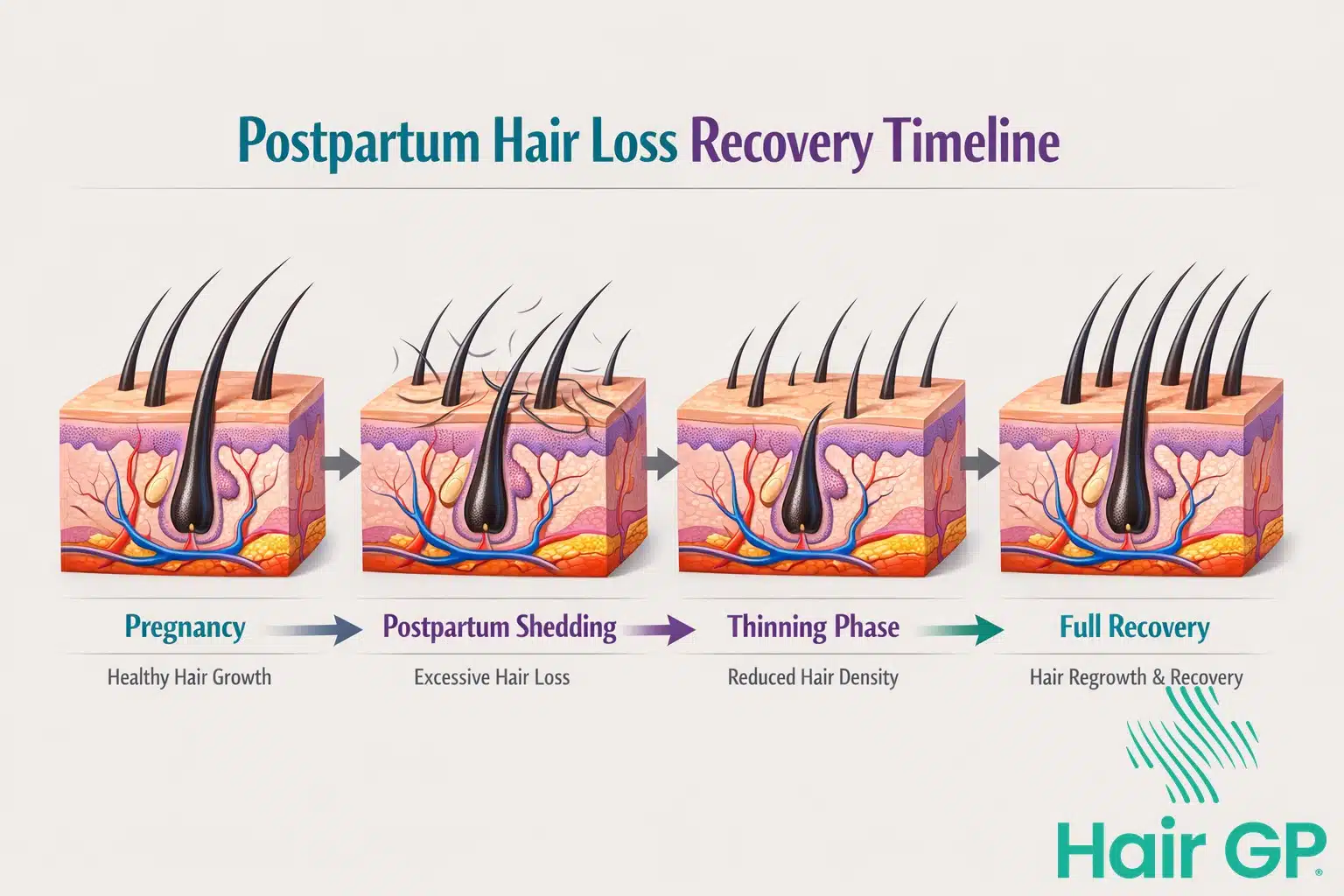
A few important caveats. Breastfeeding can extend this timeline — some women don’t hit peak shedding until after weaning. With second and subsequent pregnancies, recovery may take longer and hair may not return to full pre-pregnancy density. If shedding hasn’t improved by 12 months postpartum, specialist assessment is recommended — something beyond normal postpartum TE may be at play. And recovery always feels slow. Hair grows at approximately 1cm per month, so even when follicles are recovering, the visible results take time.
When Postpartum Hair Loss Doesn’t Resolve
For most women, postpartum hair loss is self-limiting. But for a significant minority, it doesn’t fully resolve — and this is where proper diagnosis makes the difference between years of confusion and a clear path forward.
Unmasked female pattern hair loss. This is the most common reason postpartum shedding doesn’t resolve. The hormonal upheaval of pregnancy reveals underlying FPHL that was previously too subtle to notice. The telogen effluvium resolves on schedule, but density doesn’t come back to what it was — because FPHL has been progressing quietly in the background. This won’t improve on its own. It needs treatment.
Persistent nutritional depletion. Pregnancy and breastfeeding drain iron, ferritin, vitamin D, and zinc. If these aren’t adequately replenished, the hair cycle can’t recover properly. GPs often check basic haematology postpartum but miss ferritin — which can drive ongoing shedding even when it’s technically “in range” by standard lab thresholds. A proper blood panel catches this.
Postpartum thyroiditis. This affects up to 10% of new mothers and can cause hair loss that mimics or overlaps with standard postpartum shedding. Without thyroid function testing, it’s easily missed — and easily treated once identified.
Worse with each pregnancy. Some women notice their hair never fully recovers after a first baby, then gets noticeably thinner after a second or third. This cumulative pattern typically indicates FPHL accelerating with each hormonal upheaval — and the same mechanism continues into perimenopause and menopause. Women in this situation have usually already been told to “just wait” — and waiting hasn’t worked.

The bottom line: “just wait” is only good advice once you’ve ruled out the things that won’t resolve with waiting.
Book a Consultation
If you're experiencing postpartum hair loss, a proper diagnosis is the first step toward the right treatment.
Our consultation includes a full clinical assessment, dermoscopy, and a personalised treatment plan — all in a single appointment.
Book your consultation today — £300Including assessment, and treatment plan. See full pricing
Breastfeeding and Hair Loss Treatment — What’s Safe?
This is the question every new mother asks — and the one most clinics avoid answering. Some clinics won’t even see breastfeeding women. At Hair GP, we take a different approach: assess now, plan now, treat when the time is right.
Generally considered safe during breastfeeding:
- Iron supplementation (when blood tests confirm deficiency or low ferritin)
- Vitamin D supplementation
- Continuing postnatal vitamins
- Gentle hair care practices
- Low-level light therapy — non-invasive with no systemic absorption
- PRP therapy — uses your own blood with no external medications; timing depends on individual circumstances
Requires caution or should be deferred:
- Topical minoxidil — can be absorbed through the scalp and may pass into breast milk. Limited research exists on infant exposure, and most specialists advise waiting until breastfeeding has finished
- Oral minoxidil — a systemic medication; not recommended during breastfeeding
- Spironolactone — contraindicated during breastfeeding
The practical reality is that many new mothers can’t start medical treatment immediately — and that’s completely fine. What you can do is get properly assessed while still nursing, so that when you’re ready to treat, you already have a diagnosis and a plan. This avoids losing months after weaning to starting from scratch.
Getting assessed early — even if treatment needs to wait — means you’re ready to act the moment breastfeeding ends.
Treatment Options for Postpartum Hair Loss
For shedding that hasn’t resolved, or when underlying FPHL is diagnosed alongside postpartum loss, several evidence-based treatments can help. Treatment is tailored to your specific diagnosis and breastfeeding status.
Nutritional Correction
This is first-line for all postpartum women — and the step most often overlooked. Ferritin levels should be above 70 μg/L for optimal hair growth, not simply above the standard “in range” threshold of 15 μg/L. Iron-rich foods, targeted supplementation guided by blood results, and adequate vitamin D, B12, zinc, and protein all support recovery. Protein intake deserves particular attention — it often drops with the disrupted eating patterns of new motherhood.
Nutritional correction alone won’t resolve FPHL, but it’s an essential foundation without which other treatments work less effectively.
Minoxidil (Topical & Oral)
Minoxidil is typically started after breastfeeding has finished, or with medical guidance if you’re not nursing. It works by extending the hair growth phase and supporting follicle recovery — and is particularly useful when postpartum TE has unmasked underlying FPHL. Both topical and oral formulations are available, with oral minoxidil increasingly preferred for its ease of use.
Anti-Androgen Treatments
Spironolactone is appropriate when FPHL is confirmed as the underlying cause of ongoing thinning. It blocks the effect of androgens on the hair follicle. Spironolactone is only suitable after breastfeeding has finished and when reliable contraception is in place.
PRP Therapy
PRP therapy uses concentrated growth factors from your own blood to support follicle recovery and regrowth. It involves no external medications, and timing during breastfeeding can be discussed on an individual basis.
Low-Level Light Therapy
Low-level light therapy is non-invasive and generally considered safe during breastfeeding. It stimulates cellular activity in the hair follicles and can serve as an early supportive measure. Home-use devices are available — a practical consideration for new mothers.
What Won’t Help
“Hair growth” shampoos and serums won’t resolve postpartum shedding. The process is hormonally driven from inside the body — topical products can’t reverse it. Biotin supplements are unlikely to help unless you have a confirmed deficiency, which is rare. More importantly, biotin supplementation can interfere with thyroid blood test results — and that matters, because postpartum thyroiditis is a real possibility that needs accurate testing.
Avoiding washing your hair won’t slow the shedding. Hair in the telogen phase will fall regardless. Washing simply concentrates it so it looks more dramatic. And “postpartum hair vitamins” marketed to new mothers are often overpriced, underdosed, and addressing the wrong problem.
If it’s been 12 months and shedding hasn’t improved, patience is no longer a strategy. Investigation is.
Postpartum Hair Loss Treatment at Hair GP
At Hair GP, we understand that hair loss during early motherhood adds a burden on top of everything else you’re managing — and we take it seriously.
Our clinic is female doctor-led, with a specialist focus on women’s hair loss at every life stage — including postpartum, menopause, and hormonal conditions. We run a comprehensive blood panel if needed that goes well beyond the basic postnatal check, covering ferritin, iron studies, thyroid function, vitamin D, and hormones. Trichoscopic assessment confirms whether your shedding is pure TE or whether FPHL is also present. Crucially, we take a breastfeeding-aware approach: we’ll assess and diagnose while you’re nursing, and build a treatment plan timed to your circumstances. When the time is right, we can prescribe the full range of treatments that trichologists and salons cannot — from our central London clinic in London.
Hair loss after pregnancy not resolving? Book a consultation with our female hair loss specialists for a proper diagnosis — even if you’re still breastfeeding.
Understand what's causing your hair loss
A 50-minute consultation with Dr Amy includes scalp microscopy, and a personalised treatment plan—giving you definitive answers rather than continued guessing.
Book Your Hair Loss Assessment£300 consultation | Parsons Green, London
Next-day appointments often available






What Patients Say
Frequently Asked Questions
In most cases, no. The telogen effluvium that causes postpartum shedding is temporary and resolves within 6–12 months. However, if the shedding has unmasked underlying female pattern hair loss, that component does need treatment. A specialist assessment can tell you which you’re dealing with.
Shedding typically starts 2–4 months after delivery, peaks at 3–5 months, and gradually improves from 6 months onward. Most women see significant recovery by 12–18 months. Breastfeeding can extend the timeline.
Topical minoxidil can be absorbed through the scalp and may pass into breast milk. Most hair loss specialists advise waiting until breastfeeding has finished. You can, however, get assessed and diagnosed while nursing so you’re ready to start treatment immediately after weaning.
It can be. Some women notice their hair doesn’t fully recover between pregnancies, with each cycle of hormonal change compounding the loss. This pattern often indicates underlying FPHL being accelerated by each pregnancy.
Biotin deficiency is extremely rare. Unless confirmed by blood test, biotin supplements are unlikely to help — and they can interfere with thyroid test results. This is particularly important postpartum, given the risk of postpartum thyroiditis. A comprehensive blood panel is far more useful.
If shedding hasn’t improved by 12 months postpartum, if your hair didn’t recover between pregnancies, or if you’re unsure whether what you’re experiencing is normal. Getting a proper diagnosis early — even while breastfeeding — means you’re not losing months to unnecessary worry. Book a consultation →
Breastfeeding doesn’t cause hair loss directly, but the hormonal fluctuations of nursing and the nutritional demands on your body can extend the shedding period and delay recovery. Ensuring adequate iron, protein, and vitamin D intake during breastfeeding supports hair health.