











You’ve tried minoxidil. You’ve been patient — twelve months, maybe longer — and your hair is still thinning. Or perhaps you’ve been told your hair loss is “hormonal” but nobody has offered you a treatment that actually targets the hormones responsible.
Spironolactone for hair loss is one of the most effective anti-androgen treatments available to women. It doesn’t stimulate growth the way minoxidil does. It does something more fundamental: it blocks the hormone that’s causing your follicles to shrink in the first place. For women with female pattern hair loss, PCOS-related thinning, or menopausal hair changes, that distinction matters — because treating the symptom without addressing the cause is why so many women feel they’ve “tried everything” without lasting results.
At Hair GP, Dr Amy prescribes and monitors spironolactone as part of a personalised treatment plan. It requires blood monitoring and must not be taken during pregnancy — but for the right candidate, it addresses the root hormonal driver that other treatments leave untouched.
Why Most Women Can’t Access Spironolactone for Hair Loss
Spironolactone has been available since the 1960s. It’s inexpensive, off-patent, and well understood — yet most women with hormonal hair loss have never been offered it.
Your GP can prescribe spironolactone. It’s available on the NHS. But most GPs won’t prescribe it specifically for hair loss because it’s off-label for this purpose, and hair-specific monitoring sits outside their usual scope. They’ll prescribe it for blood pressure, for PCOS, for acne — but hair loss gets a suggestion to try minoxidil from a pharmacy, or a referral to dermatology with a twelve-month wait.
The clinics that mention spironolactone often can’t prescribe it either. Surgery-focused clinics discuss it on their blogs but their business is transplants, not ongoing medical management. Skin clinics cover it generically alongside acne. And the big information sites are US-focused and can’t prescribe anything.
Hair GP exists in that gap. Dr Amy has the diagnostic expertise to confirm whether your hair loss has a hormonal component, the prescribing authority to issue the prescription, the monitoring framework to keep you safe, and the ability to prescribe minoxidil alongside it when combination therapy is indicated — something no pharmacy, most normal GPs, and no surgery-focused clinic offers as a coordinated approach.
How Spironolactone Works for Hair Loss
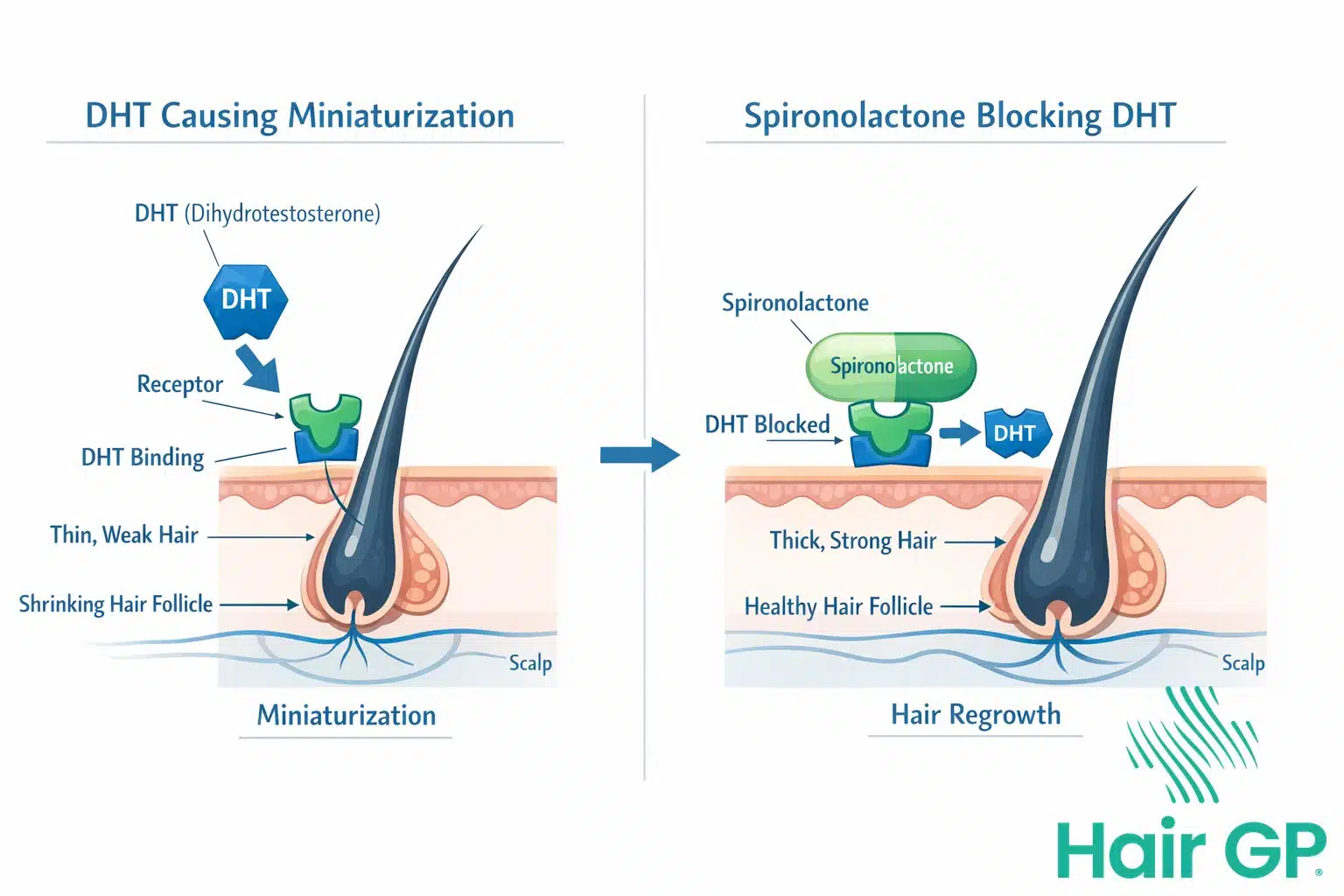
The hormone behind most women’s pattern hair loss is DHT — dihydrotestosterone. It binds to receptors in genetically sensitive hair follicles, triggering miniaturisation: each growth cycle, the follicle produces a thinner, shorter hair until eventually it stops producing visible hair altogether.
Spironolactone interrupts this in two ways. It blocks androgen receptors in hair follicles, preventing DHT from binding. And it reduces circulating androgen production, lowering the overall hormonal load on vulnerable follicles.
This is fundamentally different from how minoxidil works. Minoxidil is a vasodilator — it increases blood flow to follicles and extends the active growth phase. Effective, but it doesn’t touch the hormonal cause. If DHT is driving your follicles to shrink, minoxidil encourages growth while the damage continues underneath.
That’s exactly why the two are often prescribed together. Spironolactone stops the damage. Minoxidil promotes recovery. Different tools for different parts of the same problem.
For women with PCOS specifically, there’s another dimension. Because spironolactone blocks androgens systemically, it can simultaneously reduce hormonal acne and unwanted facial or body hair — hirsutism — which are driven by the same imbalance. One medication addressing three symptoms is why it’s considered particularly valuable for polycystic ovary syndrome.
Who Benefits Most from Spironolactone?
Spironolactone works best where hair loss has a hormonal driver — and the common thread across all candidates is androgens playing a role in thinning.
The most common use is in female pattern hair loss where thinning follows the classic diffuse pattern across the crown and parting. If blood tests show elevated androgens, or your pattern and family history suggest androgen sensitivity, spironolactone addresses the underlying mechanism that minoxidil alone doesn’t reach.
Women with PCOS-related hair loss often see the most dramatic benefit. PCOS drives scalp thinning, acne, and excess facial hair through the same androgen pathway — spironolactone can improve all three simultaneously.
Perimenopausal and menopausal hair loss responds well when androgens are part of the picture. As oestrogen declines, the relative influence of circulating androgens increases, and follicles that were previously protected become vulnerable.
Women who haven’t responded to minoxidil alone are strong candidates. If you’ve used topical minoxidil or oral minoxidil consistently without sufficient improvement, the missing piece may be hormonal.
Spironolactone is not suitable for pregnant women or those planning pregnancy — it risks feminisation of a male foetus. Reliable contraception is non-negotiable for pre-menopausal women. It’s also contraindicated in women with kidney disease, hyperkalaemia, or Addison’s disease, and requires careful assessment alongside ACE inhibitors, ARBs, or potassium-sparing diuretics. You will need regular blood tests whilst you are on the medication.
cta_secondary
Clinical Evidence
Spironolactone for hair loss has no marketing budget — it’s generic and off-patent. But the evidence is substantial and consistent.
Famenini et al. (2015) found that 75% of women with female pattern hair loss showed improvement on spironolactone — a response rate that compares favourably with topical minoxidil. Burns and Sinclair (2005) demonstrated that high-dose spironolactone (200mg) matched cyproterone acetate, a more potent anti-androgen with a heavier side-effect profile, establishing spironolactone as the first-line option with better tolerability.
A 79-patient retrospective study found that women with moderate to severe hair loss achieved nearly a full grade of improvement — but the crucial detail was timing. Two-thirds saw their best results at twelve months or beyond. This is not a treatment that delivers quick wins.
The most compelling case for combination therapy comes from a 2023 meta-analysis: spironolactone alone produced 43% improvement, rising to 66% combined with minoxidil. The Sinclair pilot study went further, finding synergistic benefits from just 25mg spironolactone with 0.25mg oral minoxidil — even modest doses together outperformed either alone.
Spironolactone + Minoxidil — The Combination Approach
The meta-analysis makes the case: combined therapy outperforms monotherapy, improvement rates rising from 43% to 66%. Spironolactone blocks the hormonal damage while minoxidil stimulates recovery — stopping the leak and bailing out the water simultaneously.
At Hair GP, Dr Amy prescribes both medications and monitors them together, adjusting doses based on your response. This coordination matters. If your GP prescribes spironolactone (uncommon for hair loss), they aren’t managing your minoxidil with hair-specific monitoring. If a pharmacy sells you topical minoxidil, nobody assesses whether the hormonal component needs addressing.
Book a Consultation
Interested in spironolactone? A thorough assessment ensures it's the right option for your specific type of hair loss.
Our consultation includes a full clinical assessment, dermoscopy, and a personalised treatment plan — all in a single appointment.
Book your consultation today — £300Including assessment, and treatment plan. See full pricing
Spironolactone with topical minoxidil is the most common starting combination. Spironolactone with oral minoxidil suits women who can’t tolerate topical application or whose follicles lack the enzyme to activate it. Spironolactone with certain oral contraceptive formulations — particularly drospirenone-containing pills — adds an additional anti-androgenic layer while providing essential contraception.
Dosage, Timeline, and Side Effects
Treatment typically starts at 25–50mg daily, titrated upward to 50–200mg based on your response, tolerance, blood results, and other medications. Pre-menopausal women often start lower; post-menopausal women may tolerate higher doses comfortably.
Reduced shedding is usually the first visible change, appearing within one to three months. Early improvement in density becomes apparent between three and six months — hair feels fuller, though changes may still be subtle to others. More significant, visible improvement typically occurs between six and twelve months. Best results come at twelve months and beyond, with studies consistently showing continued improvement past the first year. Long-term continuation is recommended for women responding well.
Breast tenderness is the most common side effect, usually settling within the first few months. Menstrual irregularities in pre-menopausal women are often resolved by combining with the oral contraceptive pill. Dizziness when standing quickly is most noticeable early in treatment and typically improves. Increased urination is expected — spironolactone is a diuretic.
Elevated potassium is the side effect that requires monitoring and is why blood tests are part of the protocol. Avoid excessive quantities of high-potassium foods — bananas, oranges, spinach, potatoes — though normal dietary amounts are fine. Fatigue and reduced libido are uncommon and usually dose-related.
Blood pressure is checked before starting. Baseline bloods assess potassium and kidney function. Repeat tests at three-six months, then annually, with more frequent checks if needed.

How Hair GP Prescribes Spironolactone
Your consultation begins with a full medical history, trichoscopy assessment, and blood test review (most patients bring their NHS results however we have our own hair-specific panel — checking androgen levels, potassium, kidney function, and nutritional factors which can be arranged if needed). Spironolactone is only prescribed after confirming a hormonal component to your hair loss.
Dosing is personalised and titrated gradually. If you’re pre-menopausal, the contraception discussion happens before prescribing begins — Dr Amy discusses options including formulations that complement spironolactone’s anti-androgenic effects.
Ongoing monitoring tracks your response through clinical photography and trichoscopy at each follow-up, reviews blood results, and adjusts dosing. If combination therapy with minoxidil is appropriate, it’s prescribed and monitored alongside — no referrals back to your GP, no coordinating between providers.
You won’t be handed a prescription and left to manage alone. The prescribing is the beginning of a treatment relationship, not a transaction.
Book a Consultation
If your hair loss has a hormonal component — whether that’s female pattern hair loss, PCOS, or menopausal thinning — spironolactone addresses the cause in a way that growth stimulants alone cannot.
Our comprehensive hair loss consultation includes a full medical history review, trichoscopy assessment, blood test review, and a clear recommendation on whether spironolactone — alone or in combination — is right for you.
Book your consultation today — £300 including assessment, and treatment plan.
See our pricing page for full details.
Understand what's causing your hair loss
A 50-minute consultation with Dr Amy includes scalp microscopy, and a personalised treatment plan—giving you definitive answers rather than continued guessing.
Book Your Hair Loss Assessment£300 consultation | Parsons Green, London
Next-day appointments often available






What Patients Say
Frequently Asked Question
Technically yes — spironolactone is available on the NHS. However, most GPs don’t prescribe it specifically for hair loss as it’s off-label for this use and requires hair-specific monitoring. A specialist like Dr Amy has the expertise to dose and monitor it for hair loss specifically, and to combine it with other treatments when needed.
Completely different mechanisms. Spironolactone blocks the hormonal cause — it prevents DHT from binding to hair follicle receptors and triggering miniaturisation. Minoxidil stimulates blood flow and hair growth directly. They work on different parts of the problem, which is why they’re often more effective used together. Read more about oral minoxidil and topical minoxidil.
Yes — combining spironolactone with oral contraceptives is common practice. The pill provides essential contraception (spironolactone must not be taken during pregnancy) and certain formulations, particularly those containing drospirenone, have additional anti-androgenic benefits that complement spironolactone’s effect.
Yes — spironolactone manages rather than cures hormonal hair loss. If you stop, the androgenic influence on your follicles resumes and thinning will gradually return. Most women who see good results continue treatment long-term.
Yes — its anti-androgen effect can reduce unwanted facial and body hair growth (hirsutism). This is one reason it’s particularly effective for women with PCOS, where scalp thinning and excess body hair are driven by the same hormonal imbalance.
Reduced shedding typically appears within one to three months. Visible improvement in hair density usually takes six to twelve months, with studies consistently showing best results at twelve months or beyond. Patience and consistency are essential.
Spironolactone can raise potassium levels, so avoid excessive consumption of high-potassium foods — bananas, oranges, spinach, and potatoes in large quantities. Your blood potassium will be monitored regularly. Normal amounts of these foods are fine; it’s the excessive intake that matters.