










If you’ve noticed your hair thinning as you approach or go through menopause, you’re far from alone. Over 50% of women experience noticeable hair changes during the menopause transition — yet it’s something that catches most women off guard.
The reason is hormonal. As oestrogen levels decline, androgens gain a relatively greater influence over the hair follicles, causing them to gradually produce finer, thinner strands. The process is often slow, which makes it easy to dismiss in the early stages — but menopause hair loss is treatable, especially with early intervention.
At Hair GP, our female doctor-led clinic in London specialises in women’s hair loss at every life stage, including the complex hormonal changes that come with perimenopause and menopause.
Why Does Menopause Cause Hair Loss?
Throughout your reproductive years, oestrogen plays a quiet but important protective role for your hair. It helps extend the anagen (growth) phase of the hair cycle and supports follicle health. When oestrogen levels drop during menopause, that protective buffer is reduced.
This doesn’t necessarily mean your androgen levels rise. It’s the ratio that shifts. With less oestrogen in the picture, androgens — particularly DHT (dihydrotestosterone) — have a greater relative effect on the hair follicles. In women with a genetic sensitivity, DHT causes follicles to miniaturise, producing progressively thinner, shorter hairs with each growth cycle.
These changes often begin earlier than women expect. Perimenopause can start in the mid-40s — sometimes earlier — meaning hair changes may appear years before periods actually stop. The average age of menopause in the UK is 51, but the hormonal shifts leading up to it can span a decade.
Hormones aren’t the only factor at play. Deficiencies in iron, ferritin, vitamin D, and thyroid function become more common with age and can compound hormonal hair loss. Insulin resistance also increases around menopause, which reduces sex hormone-binding globulin (SHBG) and allows more free testosterone to circulate — further fuelling follicle miniaturisation.

The most common type of hair loss triggered by menopause is female pattern hair loss, though the hormonal upheaval can also trigger other types. Hair changes often begin during perimenopause, well before menopause is confirmed.
Perimenopause Hair Loss: When Does It Start?
Hair loss linked to hormonal change often begins during perimenopause — the transition phase that can start in the mid-40s, sometimes earlier. Fluctuating oestrogen levels during this period can disrupt the hair cycle even before periods become irregular. Many women seeking help for hair thinning are actually in perimenopause, not yet post-menopausal.
Signs of Menopause-Related Hair Loss
The signs tend to develop gradually, which is part of what makes them easy to dismiss or attribute to ageing. Common signs include:
- A widening parting — often the first thing women notice
- Overall thinning across the crown, rather than a receding hairline
- More hair in the brush, shower drain, or on your pillow
- A ponytail that feels noticeably thinner or less dense
- Changes in hair texture — finer, drier, or more brittle than before
- Scalp becoming more visible in photographs or under bright light
- Increased facial hair on the chin or upper lip — a sign of androgen influence

An important distinction: gradual thinning concentrated at the crown and parting typically points to hormonal hair loss (FPHL accelerated by menopause). Sudden, heavy shedding across the entire scalp is more likely to be telogen effluvium — triggered by the hormonal upheaval of menopause itself, or by stress, illness, or medication changes common at this life stage.
The two can co-exist, which is one reason professional diagnosis matters.
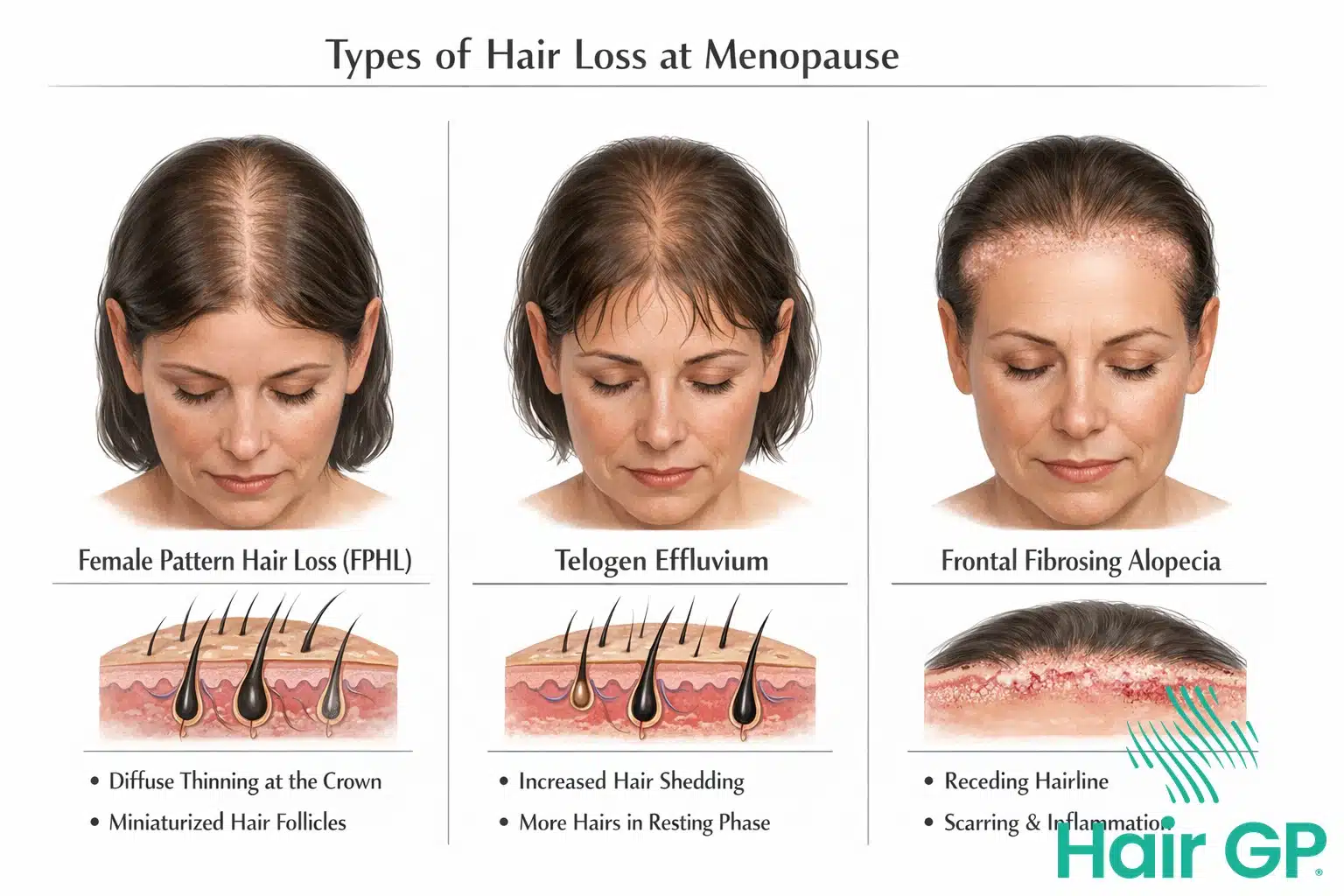
Types of Hair Loss at Menopause
Menopause doesn’t cause just one type of hair loss. Several distinct conditions can develop around this time, and they each require different treatment approaches.
Female pattern hair loss (FPHL) is the most common. It causes gradual miniaturisation of hair follicles, typically at the crown and parting. There is usually a genetic component that is unmasked or accelerated by the hormonal shift of menopause. Read more about female pattern hair loss.
Telogen effluvium is a temporary but often distressing form of widespread shedding. It can be triggered by the hormonal upheaval of menopause itself, or by concurrent stressors such as sleep disruption, weight changes, or starting new medications. More on telogen effluvium.
Frontal fibrosing alopecia (FFA) is less common but increasingly recognised in postmenopausal women. It causes a slow recession of the hairline and often affects the eyebrows as well. FFA is a scarring form of alopecia, meaning early specialist diagnosis is essential to prevent permanent loss.
Multiple types can co-exist in the same person. A woman going through menopause might have underlying FPHL worsened by a bout of telogen effluvium, for example. This is why accurate diagnosis — not guesswork — is the starting point for effective treatment.
How Is Menopause Hair Loss Diagnosed?
Getting the diagnosis right matters because different types of hair loss need different treatments. Treating telogen effluvium as though it were FPHL — or missing a thyroid problem entirely — wastes time, money, and hair.
A specialist assessment typically includes a clinical scalp examination, looking at the pattern of thinning, follicle density, and scalp health. Trichoscopy (dermoscopy of the scalp) provides a magnified, non-invasive view that can reveal miniaturisation and other changes invisible to the naked eye.
Blood tests are particularly important at this life stage. A comprehensive hair loss panel should include a hormone profile (oestrogen, testosterone, SHBG, DHEAS), thyroid function, ferritin and iron studies, vitamin D, and HbA1c to assess for insulin resistance. These markers help build a complete picture of what’s driving the hair loss.
Standard GP blood panels often don’t include these hair-specific markers, which is why many women are told their bloods are “normal” when there are actually treatable deficiencies or imbalances contributing to their thinning. A specialist hair loss consultation ensures nothing is missed.
HRT and Hair Loss: Does It Help?
This is one of the most common questions women ask — and the answer is nuanced.
The oestrogen component of HRT can be protective for hair. By replacing declining oestrogen, it restores some of the hormonal buffer that helps keep hair in its growth phase. Some women do notice an improvement in hair density after starting HRT.
The type of progesterone matters. Micronised (body-identical) progesterone — such as Utrogestan — is generally considered more hair-friendly than synthetic progestins. Some synthetic progestins have androgenic activity, which can actually worsen hair thinning in susceptible women.
Testosterone in HRT is increasingly prescribed for libido, energy, and mood during menopause. However, in women with genetic follicle sensitivity, testosterone supplementation can accelerate hair loss. This doesn’t mean testosterone HRT should be avoided — but it does need monitoring, particularly if hair thinning develops or worsens after starting.

The key message is this: HRT is not prescribed for hair loss, but choosing hair-friendly formulations can support hair health as part of a broader approach. If you’re already on HRT and still losing hair, that doesn’t mean HRT has failed — it means you likely need additional, targeted hair loss treatment alongside it.
Book a Consultation
If you're experiencing menopause hair loss, a proper diagnosis is the first step toward the right treatment.
Our consultation includes a full clinical assessment, dermoscopy, and a personalised treatment plan — all in a single appointment.
Book your consultation today — £300Including assessment, and treatment plan. See full pricing
Treatment Options for Menopause Hair Loss
There’s no single fix for menopause hair loss, but a combination approach — addressing hormones, stimulating follicles, and correcting underlying deficiencies — gives the best results. Treatment should be tailored to the type and severity of your hair loss.
Minoxidil (Topical & Oral)
Minoxidil is the only MHRA-licensed topical treatment for female pattern hair loss. It works by improving blood flow to the follicles and extending the growth phase of the hair cycle.
Topical minoxidil is applied directly to the scalp, usually once daily. Oral minoxidil at low doses is increasingly popular for menopausal women — it’s easier to use and may be more effective for diffuse thinning. Results typically become visible from three to six months, and treatment is ongoing.
Anti-Androgen Treatments
Spironolactone blocks androgen receptors at the follicle level, reducing the impact of DHT on hair. It’s particularly well-suited to postmenopausal women, as the pregnancy-related restrictions no longer apply. Used alongside minoxidil, it can be a highly effective combination. Also finasteride also reduces the DHT impact and we have seen good responses to this with our female patients.
PRP Therapy
Platelet-rich plasma (PRP) therapy uses concentrated growth factors from your own blood to stimulate follicle activity. The evidence base is growing, and it works best as an adjunct to medical treatment rather than a standalone approach.
Low-Level Light Therapy
Low-level light therapy (LLLT) uses specific red light wavelengths to stimulate cellular activity in the hair follicles. Clinical devices and FDA-cleared home-use devices are both available. LLLT is best used alongside other treatments.
Nutritional Optimisation
Nutritional foundations are often overlooked but can make a meaningful difference. Ferritin levels should ideally be 70+ for optimal hair growth — not simply “within range.” Vitamin D, B12, zinc, and adequate protein intake all support the hair growth cycle. Nutritional correction isn’t a replacement for medical treatment, but it’s an essential part of the picture.
Hair Transplant
FUE hair transplant may be appropriate for menopausal women with stable hair loss, a good donor area, and established medical treatment. Stabilising the loss with medication first is usually recommended before considering surgery.
Hysterectomy, oophorectomy and surgical menopause
Menopause that arrives by surgery behaves differently from menopause that arrives by calendar. When the ovaries are removed (oophorectomy), oestrogen falls overnight rather than over years — and hair often registers that cliff-edge as a pronounced shed in the months that follow, sometimes with pattern thinning unmasking faster than it would have naturally. A hysterectomy that keeps the ovaries is gentler on hormones, but it can still bring menopause forward, so hair changes in the years after surgery deserve joined-up thinking rather than surprise.
Practically: date-stamp the surgery in your history when you see us — it’s often the missing piece that makes a confusing timeline make sense. The examination separates the temporary post-surgical shed from unmasked pattern loss, blood tests fill in the hormonal picture, and where HRT is part of your care, our HRT and hair loss page covers how regimen choices interact with hair. Younger women in surgical menopause have the most to gain from getting this right early — decades of follicle protection are on the table.
What Patients Say
What Won’t Work
Hair-growth shampoos have no evidence for reversing hormonal hair loss. Most over-the-counter supplements — including many marketed as “menopause hair vitamins” — contain underdosed or irrelevant ingredients and won’t address follicle miniaturisation. Biotin, for example, only helps if you’re genuinely deficient, which is rare.
Waiting it out doesn’t work either. Unlike telogen effluvium, female pattern hair loss accelerated by menopause will not resolve on its own. Without treatment, it progresses.
Getting a proper diagnosis saves time, money, and — most importantly — hair.
Menopause Hair Loss Treatment at Hair GP
At Hair GP, we understand that menopause hair loss sits at the intersection of hormones and hair — and we treat it with that full picture in mind. Our clinic offers:
- Female doctor-led consultations — by a specialist who understands both the medical and emotional impact of hair loss during menopause
- A specialist focus on women’s hair loss — at every life stage, not as an afterthought
- Comprehensive diagnostics — including a full blood panel (if needed at additional cost) with hair-specific markers, trichoscopic assessment, and clinical evaluation
- Full prescribing capability — we can prescribe minoxidil, spironolactone, finasteride and other treatments that trichologists and salons cannot
- An approach that works alongside your menopause care — whether you’re on HRT or not, we tailor treatment to your situation
- Central London location — a welcoming, discreet environment in Parsons Green, 4 minutes from the tube.
Concerned about hair loss during menopause? Book a consultation with our female hair loss specialists.
Understand what's causing your hair loss
A 50-minute consultation with Dr Amy includes scalp microscopy, and a personalised treatment plan—giving you definitive answers rather than continued guessing.
Book Your Hair Loss Assessment£300 consultation | Parsons Green, London
Next-day appointments often available






Frequently Asked Questions
The hormonal changes that cause it are permanent, but that doesn’t mean nothing can be done. With the right treatment, most women can slow or stop further loss, and many see genuine improvement in density. Starting earlier gives better results.
HRT can help by restoring oestrogen, but results vary. The type of progesterone matters — some synthetic progestins can worsen hair thinning. If you’re on HRT and still losing hair, additional treatments like minoxidil may be needed.
Hair changes can begin during perimenopause, which typically starts in the mid-40s — sometimes earlier. By the time menopause is reached (average age 51), many women have already noticed thinning.
Menopause is often assumed to be the cause, but thyroid disease, iron deficiency, and other conditions can produce similar symptoms. Blood tests and a specialist assessment are essential to get the right diagnosis.
Most women see initial improvement within three to six months, with optimal results at around twelve months. Treatment for hormonal hair loss is ongoing — stopping typically means the loss resumes.
Yes. Stress can trigger telogen effluvium — temporary but heavy shedding — on top of existing hormonal thinning, making the overall situation feel much worse. Managing stress is an important part of a comprehensive approach.