











Finding clumps of hair in the shower, on your pillow, or wound around your fingers is genuinely alarming. If this is happening to you, there’s a good chance you’re experiencing telogen effluvium (TE) — a disruption to the hair growth cycle that causes widespread, sudden shedding.
Telogen effluvium is the most common cause of sudden hair loss in women. The reassuring news is that it’s usually temporary and usually reversible. However, when shedding doesn’t resolve on its own — or when the diagnosis isn’t as straightforward as it seems — specialist investigation matters. At Hair GP, our doctor-led clinic helps women get to the root cause and build a clear path to recovery.
What Is Telogen Effluvium?
To understand telogen effluvium, it helps to know how the hair growth cycle works. At any given time, around 85% of your hair follicles are in the anagen (growth) phase, while 10–15% are in the telogen (resting) phase. Hair in the telogen phase eventually sheds to make way for new growth. This is normal — most people lose 50–100 hairs a day without noticing.
In telogen effluvium, a stressor pushes up to 30–50% of follicles into the telogen phase simultaneously. The result is a dramatic increase in shedding — often 200–300+ hairs per day — that can feel overwhelming.
There’s a detail that catches many women off guard: the shedding doesn’t begin at the time of the trigger. It typically starts two to three months afterwards, because that’s how long it takes for telogen hairs to work loose and fall. This delay is why so many women struggle to connect their hair loss to the event that caused it.
The thinning is diffuse — spread across the entire scalp rather than appearing in patches or at the hairline. The condition was first described by Kligman in 1961 and is well understood, even if the experience of it feels anything but routine.

In telogen effluvium, a significantly increased number of hair follicles prematurely shift into the telogen (resting) phase, leading to diffuse hair shedding.
What Triggers Telogen Effluvium?
A wide range of physical, hormonal, and emotional stressors can trigger TE. The common thread is that the body experiences something significant enough to disrupt the hair cycle.
Physical stress:
- Surgery or general anaesthetic
- Severe illness, high fever, or COVID-19
- Crash dieting or rapid weight loss — including weight loss from GLP-1 medications such as Ozempic and Wegovy. The body treats rapid weight loss as a physical stressor regardless of how it’s achieved, triggering the same hair cycle disruption as a crash diet
- Iron deficiency or nutritional depletion
Hormonal changes:
- Postpartum — the single most common trigger in women
- Starting or stopping hormonal contraception
- Perimenopause and menopause
- Thyroid dysfunction
Emotional stress:
- Bereavement, divorce, or job loss
- Chronic anxiety or prolonged stress
- Emotional stress alone can trigger TE, though it’s often compounded by other factors such as poor sleep or dietary changes
Medications:
- Beta-blockers, anticoagulants, retinoids, and some antidepressants can trigger shedding
- If you suspect a medication is contributing, always discuss this with your prescribing doctor before stopping
No identifiable trigger: In roughly one in three cases, no clear cause is found. This doesn’t mean there isn’t one — it usually means further investigation is needed, including comprehensive blood tests and a thorough clinical history.

Signs and Symptoms
The hallmark of telogen effluvium is sudden, excessive shedding. Common signs include:
- Losing noticeably more hair than usual — often 200–300+ hairs per day, compared to a normal 50–100
- Hair on your pillow, in the shower drain, on your clothes, or coming away in your hands when you run your fingers through
- Overall thinning — hair feels lighter, a ponytail feels thinner, and more scalp becomes visible
- The thinning is diffuse and uniform, not concentrated in patches or at the hairline
- Some women experience trichodynia — a tingling, tenderness, or prickling sensation in the scalp
- The onset is sudden, which is what distinguishes TE from other forms of hair loss

If your hair loss appears in distinct round patches, you may have alopecia areata, which has different causes and treatment. If your thinning is gradual and concentrated at the crown or parting, it may be female pattern hair loss.
Acute vs Chronic Telogen Effluvium
This distinction is critical — and it’s where many women are let down by generic advice.
Acute telogen effluvium follows a single identifiable trigger and lasts less than six months. It is self-resolving in the vast majority of cases. Once the trigger is addressed, the hair cycle resets and regrowth begins. Around 95% of acute TE cases resolve without treatment, and hair typically returns to normal within 6–12 months.
Chronic telogen effluvium lasts six months or longer, sometimes years. It may have no clear single trigger, and it predominantly affects women aged 30–60 — particularly those going through hormonal transitions such as perimenopause and menopause. The course tends to fluctuate — episodes of heavier shedding interspersed with calmer periods. Chronic TE does not cause complete baldness, but it can significantly reduce hair density and volume over time.
Here’s the important part: chronic TE can coexist with female pattern hair loss, and this is where misdiagnosis happens. Many women are told “it’s just TE, it’ll grow back” and left without further investigation. But if underlying FPHL is present, density won’t fully recover without targeted treatment.
Hair GP’s approach is to investigate thoroughly rather than assume shedding will simply resolve. Trichoscopy, comprehensive blood work, and a detailed clinical history can distinguish between pure TE, chronic TE, underlying FPHL, or a combination — and each requires a different management plan.
Book a Consultation
If you're experiencing telogen effluvium, a proper diagnosis is the first step toward the right treatment.
Our consultation includes a full clinical assessment, dermoscopy, and a personalised treatment plan — all in a single appointment.
Book your consultation today — £300Including assessment, and treatment plan. See full pricing
How Is Telogen Effluvium Diagnosed?
The most important diagnostic question isn’t “what tests do I need?” — it’s “what was happening in my life two to three months ago?” Because of the delayed onset of TE, connecting the shedding to its trigger is often the single most useful step. A detailed medical history, combined with a clinical scalp examination, forms the foundation of diagnosis.
A pull test — where gentle traction is applied to a small section of hair — can confirm active shedding. Trichoscopy (dermoscopy of the scalp) is essential for distinguishing TE from FPHL. In pure TE, there is no follicle miniaturisation. If miniaturisation is present, FPHL may be contributing — and that changes the treatment approach entirely.
Blood tests are a cornerstone of diagnosis. One of the most common findings is low ferritin — levels below 40 μg/L can drive shedding even when they’re technically “within range” on a standard lab report. A comprehensive hair loss panel also includes thyroid function, vitamin D, zinc, B12, folate, and a hormonal profile (FSH, LH, oestradiol, testosterone, SHBG, DHEA-S) where perimenopause or PCOS is suspected.
Blood tests are particularly important because TE can be the presenting symptom of thyroid disease, iron deficiency anaemia, or hormonal imbalance. Standard GP panels often check basic haematology but miss ferritin, vitamin D, and hormonal markers — which is why many women are told their results are “normal” when there’s actually a treatable deficiency driving the shedding.
Self-diagnosis is risky. Without a specialist assessment, it’s difficult to distinguish TE from early FPHL or early scarring alopecia — and getting this wrong means the wrong treatment, or no treatment at all.
Treatment for Telogen Effluvium
Acute TE usually resolves on its own once the trigger is addressed. But when shedding persists, when hair density isn’t recovering, or when an underlying condition is contributing, medical treatment can make a significant difference.
Address the Trigger
This is the single most important step in treating telogen effluvium — and the one most often skipped.
If the trigger was a nutritional deficiency, correcting it is the treatment. If it was thyroid dysfunction, managing the thyroid is the treatment. If a medication is responsible, a review with the prescribing doctor is the treatment. Everything else — minoxidil, PRP, light therapy — is supportive. Without resolving the underlying cause, those treatments are working against the current.
The most common correctable triggers are low ferritin, vitamin D deficiency, thyroid imbalance, and inadequate protein intake. In cases where emotional or psychological stress is the driver, addressing that — whether through lifestyle changes, therapy, or simply recognising the connection — is part of the recovery.
Minoxidil
Minoxidil is not routinely needed for acute TE. However, it can be helpful in chronic TE to support regrowth and shorten recovery time. Topical minoxidil is applied to the scalp, while oral minoxidil at low doses is an increasingly popular alternative. Minoxidil is particularly useful when TE has unmasked or coexists with underlying FPHL.
PRP Therapy
Platelet-rich plasma (PRP) therapy uses concentrated growth factors from your own blood to support follicle recovery. Emerging evidence suggests it can accelerate regrowth in chronic or stubborn TE. It works best alongside trigger resolution, not as a standalone treatment. At Hair GP we use PRF which is even better for hair regrowth.
Nutritional Optimisation
Targeted supplementation — based on blood results, not guesswork — can support recovery. Ferritin targets for optimal hair growth are higher than the standard “normal” range (ideally above 70 μg/L). Iron-rich foods, adequate protein, and vitamin D all play a role. It’s worth noting that over-supplementation can also cause problems — vitamin A and selenium in excess can actually worsen hair shedding.
Low-Level Light Therapy
Low-level light therapy (LLLT) uses red light wavelengths to stimulate cellular activity in the hair follicles. The evidence base for LLLT in TE specifically is limited compared to its use in FPHL, but it can serve as a non-invasive, low-risk adjunct alongside other treatments — particularly in chronic TE where recovery is slow.
What Won’t Help
Being upfront about what doesn’t work saves you time and money.
Expensive shampoos and topicals won’t resolve TE. The problem is driven from inside the body, not the scalp surface. Biotin supplements are unlikely to help unless you have a confirmed deficiency — which is extremely rare — and supplementing can actually interfere with thyroid blood test results.
Avoiding washing your hair won’t reduce shedding. Hair that is in the telogen phase and ready to fall will fall regardless. Washing simply collects hair that would have shed anyway, which can make it look worse than it is.
Waiting indefinitely is the most common mistake. If shedding hasn’t improved after six months, or if your density isn’t recovering, don’t wait longer. Get assessed. The difference between chronic TE, unmasked FPHL, and an undiagnosed deficiency is something only a proper evaluation can determine.
Telogen Effluvium Recovery Timeline
Understanding the typical timeline helps manage expectations — and reduces the anxiety that comes with watching hair fall.
| Phase | Timeline | What to expect |
|---|---|---|
| Trigger event | Month 0 | May not be noticed at the time |
| Shedding begins | Months 2–3 | Sudden, noticeable increase in hair fall |
| Peak shedding | Months 3–4 | The most alarming period — hair may come out in clumps |
| Shedding slows | Months 4–6 | Gradual reduction, provided the trigger has been resolved |
| Regrowth visible | Months 6–9 | Short new hairs appear at the hairline and parting |
| Full recovery | Months 9–18 | Hair density returns to near-normal |
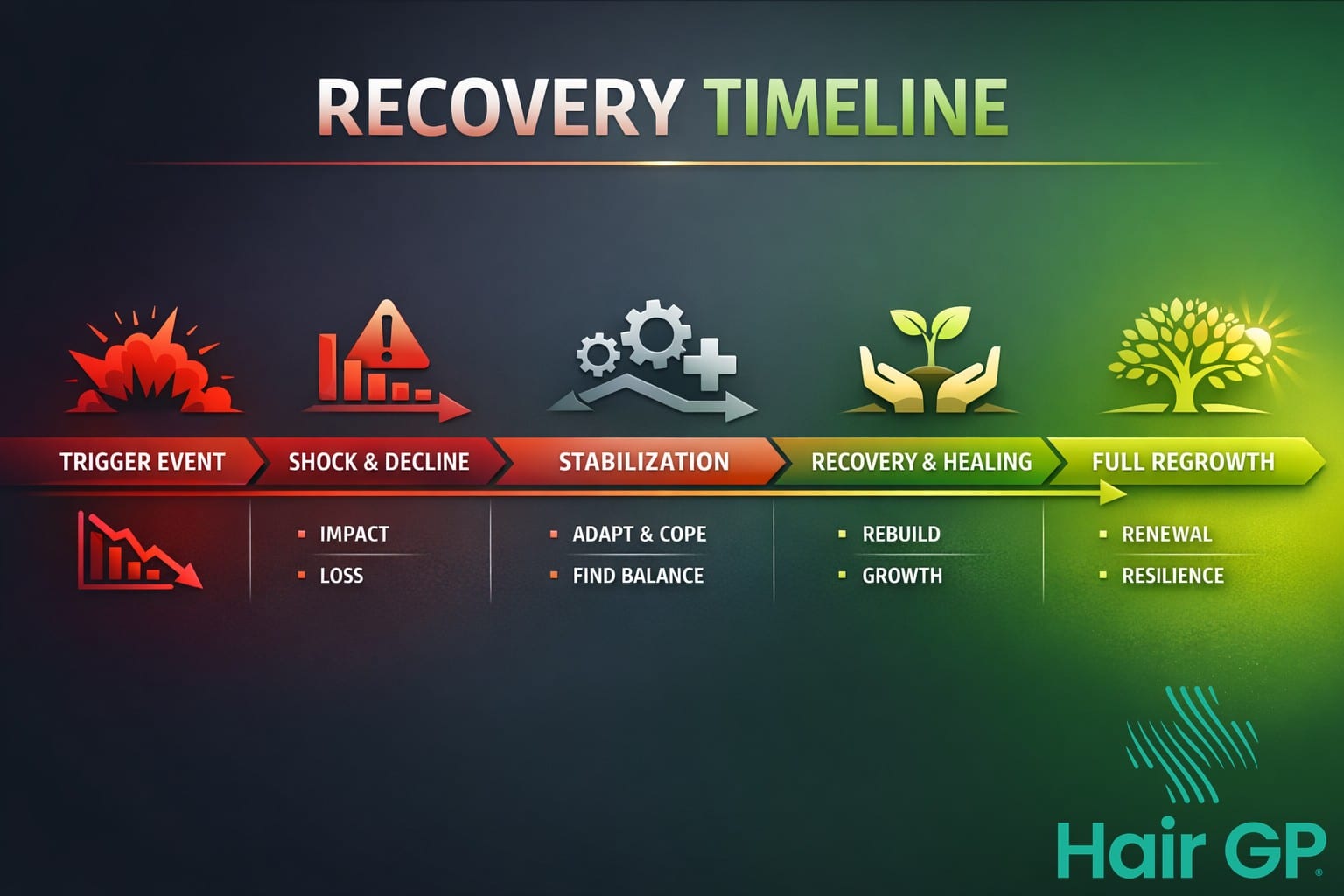
This timeline assumes the trigger has been identified and resolved. Chronic TE may not follow this pattern, and if FPHL is present alongside TE, full density may not return without treatment. Recovery often feels painfully slow, but hair grows at approximately 1cm per month — short regrowth hairs are a good sign, even when they don’t feel like enough.
Telogen Effluvium Treatment at Hair GP
At Hair GP, we don’t dismiss shedding with “it’ll grow back.” We investigate it properly. Our clinic offers:
- Doctor-led diagnosis — not trichology alone, but full medical assessment with prescribing capability
- Comprehensive blood panel — testing ferritin, thyroid, hormones, vitamin D, and other markers that standard GP panels miss (If needed this can be arranged at an additional cost)
- Trichoscopy — to confirm the diagnosis and rule out FPHL or scarring alopecia
- Personalised treatment plans — based on your findings, not a one-size-fits-all approach
- Female doctor-led care — with a deep understanding of the hormonal triggers that affect women at every life stage
- Ongoing monitoring — to track your recovery and adjust treatment if needed
Worried your hair shedding isn’t stopping? Book a consultation with our female hair loss specialists for a thorough diagnosis.
What Patients Say
Frequently Asked Questions
Acute TE usually resolves within three to six months once the trigger is addressed. Chronic TE lasts longer than six months and may require specialist investigation to identify underlying causes or coexisting conditions.
TE itself is not permanent — the follicles are not damaged. However, chronic TE can unmask underlying female pattern hair loss, which does require treatment to prevent ongoing thinning.
In most cases of acute TE, yes. Full recovery can take 9–18 months. If FPHL is also present, medical treatment may be needed to restore density fully.
Yes. Both physical and emotional stress can trigger telogen effluvium. The shedding typically starts two to three months after the stressful event, which is why many people don’t connect the two.
Biotin deficiency is extremely rare. Unless a deficiency is confirmed by blood test, biotin supplements are unlikely to help — and they can interfere with thyroid test results, potentially leading to a misdiagnosis. A comprehensive blood panel is far more useful.
Yes. Each time your body experiences a significant stressor, TE can recur. Women who experience postpartum TE may also experience it during perimenopause or after illness.
If shedding has lasted more than six months, if your hair density isn’t recovering, or if you’re unsure whether it’s TE or something else. A proper diagnosis with a specialist consultation prevents months of unnecessary worry — and catches conditions that need treatment before more hair is lost.
Understand what's causing your hair loss
A 50-minute consultation with Dr Amy includes scalp microscopy, and a personalised treatment plan—giving you definitive answers rather than continued guessing.
Book Your Hair Loss Assessment£300 consultation | Parsons Green, London
Next-day appointments often available