










If your hair has started thinning in your late 30s or 40s and you’re not sure why, perimenopause may already be underway — and it may be the reason. Up to 50% of women notice hair thinning during the menopausal transition, and hair loss before menopause is more common than most women realise — perimenopause hair loss can begin years before periods actually stop. What makes this phase different is the hormonal picture: perimenopause involves unpredictable surges and crashes in oestrogen, not just a steady decline. This creates a unique pattern of hair loss that’s distinct from what happens after menopause. The good news is that early intervention during perimenopause is actually the best time to treat, before follicle damage becomes more established. At Hair GP, our female doctor-led clinic specialises in hormonal hair loss during every stage of the menopausal transition.
What Is Perimenopause?
Perimenopause is the transitional phase leading up to menopause, when the ovaries gradually produce less oestrogen. It typically begins in the mid-40s but can start as early as the late 30s, and lasts an average of four to eight years.
What surprises many women is that perimenopause isn’t a smooth decline. It’s defined by erratic hormonal fluctuations — oestrogen can spike high one month and crash the next. This unpredictability is what drives many of the symptoms: irregular cycles, hot flushes, night sweats, mood changes, sleep disruption, and brain fog.
Hair changes — thinning, texture changes, and increased shedding — are among the most common and least discussed perimenopause symptoms. Many women don’t realise they’re perimenopausal at all. Hair loss may be the first visible sign, appearing before hot flushes, irregular periods, or other more recognised symptoms become obvious.
Diagnosing perimenopause can be difficult. Hormone tests during this phase are unreliable because levels fluctuate from day to day. A “normal” blood test one week doesn’t mean your hormones aren’t swinging wildly the next. Diagnosis is usually clinical — based on symptoms and menstrual history rather than a single snapshot of blood work. Perimenopause ends when you’ve gone 12 consecutive months without a period, at which point you’ve reached menopause.
How Perimenopause Causes Hair Loss
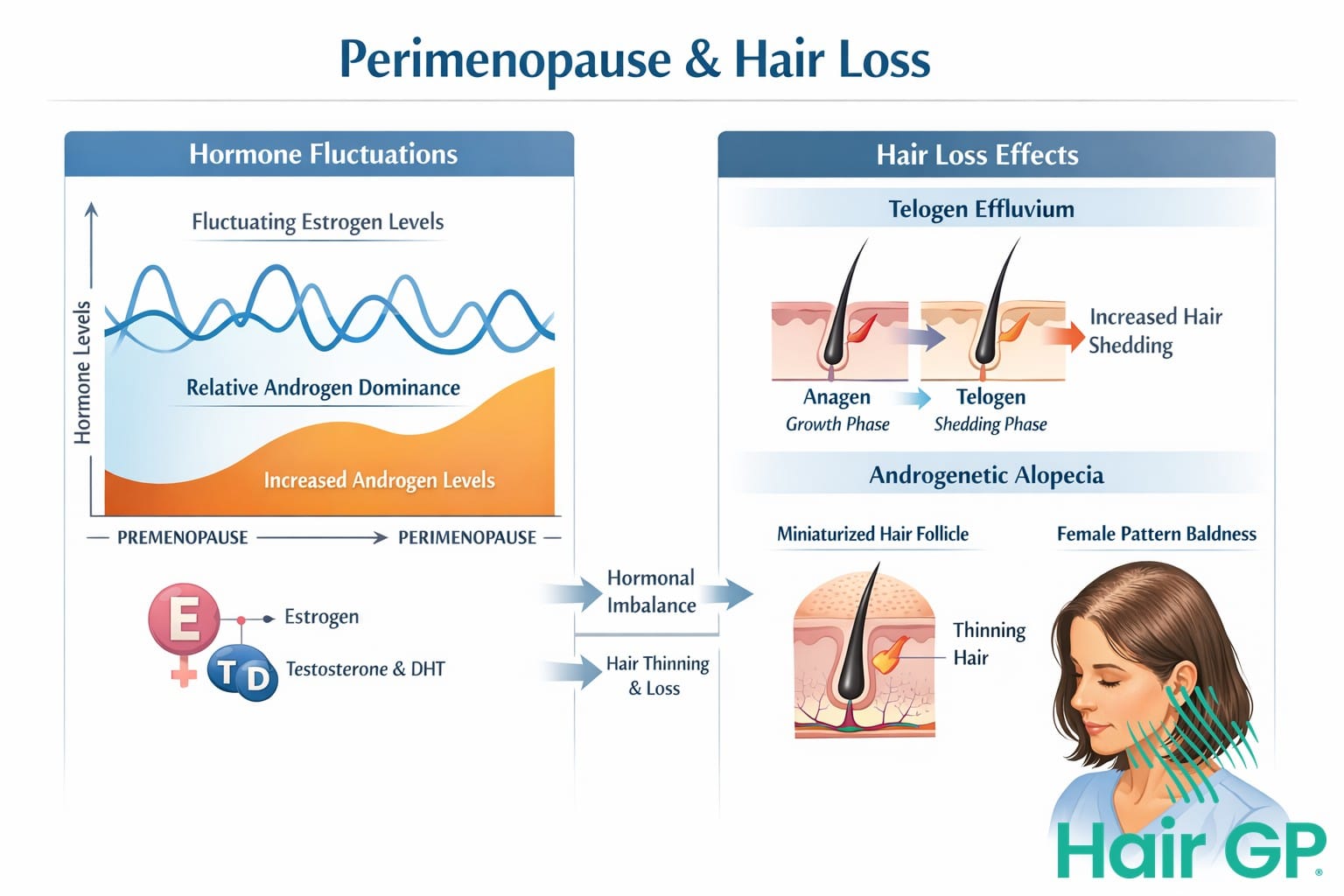
Unlike menopause, where oestrogen has settled at a new low, perimenopause is characterised by a hormonal rollercoaster. Rather than a steady decline, oestrogen levels swing unpredictably — sometimes surging, sometimes plummeting within weeks. It’s this instability that makes perimenopausal hair loss distinct. And it’s why it can involve more than one type of hair loss at the same time.
Telogen Effluvium (From Hormonal Fluctuations)
The sudden hormonal swings of perimenopause can shock hair follicles into the resting (telogen) phase prematurely. This causes diffuse shedding — more hair than usual falling out across the entire scalp. It’s reactive and often episodic: shedding may worsen, improve, then worsen again as hormones fluctuate. It can also be triggered by specific perimenopause events — stopping or starting HRT, significant hormonal shifts, or acute stress during an already destabilising phase.
→ Learn more about telogen effluvium
Androgenetic Alopecia (From Relative Androgen Dominance)
As oestrogen declines, the relative influence of androgens (testosterone, DHT) increases — even though androgen levels don’t necessarily rise. The shift in the oestrogen-to-androgen ratio exposes genetically susceptible follicles to DHT-driven miniaturisation. This causes gradual, patterned thinning at the crown, parting, and sometimes the frontal hairline. Unlike telogen effluvium, androgenetic alopecia is progressive — untreated, it continues and worsens through menopause and beyond.
→ Learn more about female pattern hair loss
The Double Hit
Many women in perimenopause experience both types simultaneously: episodic shedding (telogen effluvium) layered on top of gradual thinning (androgenetic alopecia). This is why perimenopausal hair loss can feel so overwhelming — it’s not one thing, it’s two. Distinguishing between them requires specialist assessment, because the treatments differ.
Several factors can compound the picture further:
- Iron deficiency — heavy or irregular periods during perimenopause can deplete ferritin stores, directly worsening hair shedding
- Thyroid dysfunction — thyroid disorders become more common during perimenopause and affect hair growth directly
- Stress — the cumulative burden of perimenopause symptoms (sleep disruption, mood changes, body changes) can trigger or worsen telogen effluvium
- Nutritional changes — shifting metabolism, changes in appetite, or restrictive dieting during perimenopause can starve follicles of the nutrients they need
Once perimenopause ends and menopause begins, the hormonal picture changes — and so does the hair loss pattern. Learn more about menopause hair loss →
Perimenopause vs Menopause Hair Loss: What’s Different?
This comparison matters because the treatment approach differs. During perimenopause, hormonal instability means some women respond differently to treatment month to month. The post-menopausal picture is more hormonally consistent — but the window for optimal intervention may already have narrowed.
| Feature | Perimenopause | Menopause |
|---|---|---|
| Hormonal pattern | Fluctuating — surges and crashes | Settled decline — low and stable |
| Main hair loss type | Often both TE + androgenetic | Predominantly androgenetic |
| Shedding pattern | Episodic — comes and goes | More consistent gradual thinning |
| Diagnostic challenge | High — hormone tests unreliable due to daily fluctuations | Lower — hormone levels more stable and testable |
| HRT consideration | Can be started early; timing affects hair outcomes | May still help but window of optimal benefit may narrow |
| Fertility | Still possible — treatment constraints apply | Contraception no longer needed (affects treatment options) |
| Iron risk | Higher — heavy/irregular periods can deplete ferritin | Lower — no menstrual blood loss |
The menopause hair loss page covers the post-menopausal picture in detail. This page addresses what happens before — during the transitional phase, when the hormonal landscape is at its most unpredictable and the opportunity for early intervention is greatest.

Signs of Perimenopause Hair Loss
The signs can be subtle at first, but most women recognise a combination of the following:
- Increased shedding — more hair in the shower drain, on your pillow, in your brush. Not clumps, but noticeably more than your normal baseline
- Widening parting — the central part appears broader, with more scalp visible
- Reduced ponytail volume — the hair band wraps around an extra time; the ponytail feels thinner than it used to
- Hair texture changes — hair feels finer, weaker, drier, or less manageable than before
- Crown thinning — more scalp visible at the top of the head, particularly in bright light or photographs
- Episodic shedding — shedding that worsens, improves, then worsens again — characteristic of the hormonal fluctuation pattern
- Changes in growth rate — hair seems to grow more slowly or no longer reaches the length it used to
- Hair loss alongside other perimenopause signs — if thinning coincides with irregular periods, hot flushes, mood changes, sleep disruption, or brain fog, the hormonal connection is likely
The hallmark of perimenopausal hair thinning is the combination of gradual thinning AND episodic shedding. If you’re experiencing both — a steady reduction in density alongside periods of heavier-than-usual hair fall — that’s the dual pattern of hormonal hair loss during this transitional phase.

Why Your GP Might Miss It
If you’ve been told your hair loss is “just stress” or “normal ageing” — or told to come back when menopause is confirmed — you’re not alone. Many women receive this advice, and there are real diagnostic reasons why it happens.
The core problem: Standard hormone blood tests (FSH, oestradiol) are unreliable during perimenopause because hormone levels fluctuate dramatically from day to day. A “normal” blood test doesn’t rule out perimenopause — it just means your hormones happened to be within range on that particular day. This creates a diagnostic gap where women are symptomatic but their blood work looks reassuring.
What GPs typically miss:
- Ferritin — heavy or irregular periods during perimenopause can deplete iron stores. GPs often don’t check ferritin specifically, or accept a level that’s technically “in range” but too low for optimal hair growth. Hair GP targets ferritin above 70 µg/L — far higher than the lower end of most lab reference ranges.
- Free androgen index — total testosterone may look normal, but if SHBG is low (as it often is with insulin resistance or hormonal changes), the free androgen index may be elevated, contributing to follicle miniaturisation that doesn’t show up in standard tests.
- Thyroid function — subclinical thyroid dysfunction is more common during perimenopause and can contribute to hair loss independently.
- Vitamin D — commonly deficient, linked to both hair loss and bone health, and rarely checked in the context of hair thinning.
What Hair GP does differently: We combine trichoscopic scalp assessment — to determine whether miniaturisation, telogen effluvium, or both are present — with a comprehensive blood panel that captures the markers standard GP testing misses.
This isn’t about blaming GPs. It’s about recognising that perimenopausal hair loss requires specialist diagnostics that sit outside standard general practice.
→ Book a perimenopause hair loss consultation

Book a Consultation
If you're experiencing perimenopause hair loss, a proper diagnosis is the first step toward the right treatment.
Our consultation includes a full clinical assessment, dermoscopy, and a personalised treatment plan — all in a single appointment.
Book your consultation today — £300Including assessment, and treatment plan. See full pricing
HRT and Hair: What You Need to Know
HRT is the cornerstone treatment for perimenopause symptoms, and it can help hair — but the relationship is nuanced, and most hair clinics don’t address it at all.
How HRT can help: By restoring oestrogen, HRT extends the hair growth (anagen) phase and reduces androgen dominance. It can stabilise the hormonal fluctuations that trigger telogen effluvium — meaning less episodic shedding. Some women see meaningful improvement in hair density on HRT alone.
But formulation matters — and this is where most advice falls short.
Body-identical oestrogen (oestradiol patches, gel, or spray) provides consistent hormone levels. This is better for hair than oral oestrogen, which creates hormonal peaks and troughs. The progestogen component is equally important: synthetic progestins such as norethisterone and levonorgestrel can have androgenic effects that worsen hair loss. Body-identical micronised progesterone (Utrogestan) is generally more hair-friendly.
This is a critical point that most clinics miss. The type of HRT matters for hair. Women on androgenic progestins may find their hair loss worsens despite being “on HRT” — and neither they nor their prescriber may realise the formulation is part of the problem.
Testosterone requires careful consideration. Testosterone is increasingly prescribed during perimenopause for libido, energy, and mood. At the right dose, it may support hair growth — but in genetically susceptible women, testosterone can accelerate androgenetic alopecia. This requires individualised assessment and monitoring.
Here at Hair GP we can also prescribe HRT so you don’t need to go and see a second specialist. We ensure your HRT regime is hair-friendly, and we add the hair-specific treatments that HRT alone often can’t provide. Think of it as adding the hair expertise to your existing care team.
Treatment Options for Perimenopause Hair Loss
Treatment during perimenopause requires addressing the hormonal instability AND treating the hair loss directly. The dual nature of perimenopausal hair loss — telogen effluvium plus androgenetic alopecia — means treatment plans are typically multi-pronged.
Stabilising the Hormonal Environment
HRT — when appropriate — stabilises oestrogen fluctuations, reduces androgen dominance, and may improve hair on its own. Beyond HRT, managing the metabolic changes of perimenopause matters too: insulin resistance can worsen androgen-driven hair loss, and the cumulative stress of perimenopause symptoms can trigger or compound telogen effluvium. Weight management, stress management, and sleep are all part of the picture.
Spironolactone (Anti-Androgen)
Spironolactone blocks androgen receptors at the follicle and is particularly effective for the androgenetic component of perimenopausal hair loss. It works well alongside HRT — the two target different parts of the hormonal picture. Typically prescribed at 100–200mg daily, visible improvement usually takes six to twelve months. Reliable contraception is required, as spironolactone is contraindicated in pregnancy — still relevant during perimenopause, as fertility may not have ended.
Finasteride (Anti-Androgen)
Finasteride blocks the conversion of testosterone to dihydrotestosterone (DHT), the more potent androgen that drives follicular miniaturization. While extensively studied in men, it’s used off-label in women and can be particularly effective for perimenopausal androgenetic alopecia when spironolactone alone isn’t sufficient. Typically prescribed at 2.5–5mg daily (higher than the 1mg male dose), visible improvement usually takes six to twelve months. Absolute contraception is non-negotiable, as finasteride causes severe feminization of male fetuses — perimenopause does not guarantee infertility. Some women prefer combining low-dose finasteride with spironolactone for a dual-mechanism approach.
Minoxidil (Topical & Oral)
Topical minoxidil and oral minoxidil stimulate follicle activity regardless of the underlying cause, which makes them particularly useful during perimenopause — they help both the telogen effluvium and the androgenetic components. Either form can be used safely alongside HRT and spironolactone as part of a combination approach.
Addressing Iron Depletion
Heavy or irregular periods during perimenopause are a common and underappreciated cause of iron depletion. Ferritin below 70 µg/L can significantly contribute to hair shedding — even if it’s technically “in range” on standard lab reports. Iron supplementation, or IV iron infusion for severely depleted stores, can make a meaningful difference, particularly for the telogen effluvium component.
PRP Therapy
Platelet-rich plasma (PRP) therapy stimulates follicle recovery using growth factors concentrated from your own blood. It involves no systemic medications, making it suitable alongside any hormonal treatment. PRP is most effective as part of a broader treatment plan rather than a standalone option.
Low-Level Light Therapy
Low-level light therapy (LLLT) uses specific wavelengths to stimulate cellular activity within hair follicles. It’s non-invasive with no systemic absorption, and can be used at home or in clinic as an adjunct to other treatments.
A Note on Hair Transplants
Hair transplant surgery is generally not recommended during perimenopause, as the unstable hormonal environment can compromise results. It may be considered once hormones have stabilised post-menopause and hair loss has been medically managed. Learn more about FUE hair transplant →
Nutritional Optimisation
Nutritional support won’t replace medical treatment for established hair loss, but it creates the conditions for treatment to work effectively. Key targets during perimenopause include:
- Ferritin above 70 µg/L — essential, and may require supplementation given ongoing menstrual blood loss
- Vitamin D — commonly deficient, linked to both hair loss and bone health during perimenopause
- Adequate protein — essential for hair synthesis; perimenopause is not the time for restrictive dieting
- Low-GI diet — supports metabolic health during a period of changing insulin sensitivity
Supplements support but don’t replace medical treatment.
What Won’t Help
“Wait until menopause.” The most damaging advice women receive. Follicle miniaturisation during perimenopause is progressive. Waiting means losing follicles that could have been preserved. Early treatment protects more hair than waiting ever will.
Biotin supplements (unless you’re deficient). Biotin deficiency is rare. Supplementation without confirmed deficiency is unlikely to help and can interfere with blood test results — including thyroid tests, which are particularly important during perimenopause.
Volumising shampoos and serums as treatment. These can help cosmetically, but they don’t address the hormonal causes of perimenopausal hair thinning.
Self-diagnosing from social media. Perimenopause hair loss can involve multiple overlapping types and causes. What worked for someone else’s hair may not address what’s happening to yours. Specialist assessment matters.
Restrictive dieting. Perimenopause is the worst time to crash diet. Calorie restriction and rapid weight loss trigger telogen effluvium — the exact type of shedding that’s already being triggered by your hormonal fluctuations.
Perimenopause Hair Loss Treatment at Hair GP
Hair GP is a female doctor-led clinic specialising in hormonal hair loss during the menopausal transition — from early perimenopause through post-menopause. We understand this phase from both a clinical and personal perspective.
Our approach starts with trichoscopic assessment to determine whether you’re experiencing telogen effluvium, androgenetic alopecia, or both. This distinction drives the entire treatment plan. We run a comprehensive blood panel (if needed or many patients bring along copies of their NHS blood tests for review) capturing the markers GPs typically miss — ferritin, free androgen index, SHBG, thyroid function, and vitamin D — giving us the full picture, even when standard hormone tests are unreliable.
We can prescribe the full range of hair-specific treatments: spironolactone, minoxidil (topical and oral), and PRP. We can also prescribe HRT so you don’t need to see a second specialist and ensure its hair friendly.
We don’t tell you to “wait until menopause.” We treat now, because that’s when treatment works best.
Learn more about our approach to female hair loss →
Don’t wait for menopause to take your hair seriously. Book a consultation with our female hair loss specialists for a thorough hormonal and hair assessment.
Understand what's causing your hair loss
A 50-minute consultation with Dr Amy includes scalp microscopy, and a personalised treatment plan—giving you definitive answers rather than continued guessing.
Book Your Hair Loss Assessment£300 consultation | Parsons Green, London
Next-day appointments often available






What Patients Say
Frequently Asked Questions
It depends on the type. Telogen effluvium — the shedding caused by hormonal fluctuations — is typically reversible once hormones stabilise, whether through HRT, the natural completion of the menopausal transition, or both. Androgenetic alopecia — the gradual thinning — is progressive without treatment, but can be slowed, stopped, and partially reversed with the right approach. This is particularly true when caught early during perimenopause, before miniaturisation becomes well established.
It can. HRT stabilises oestrogen levels, which may reduce shedding and slow androgenetic thinning. But formulation matters — body-identical oestrogen with micronised progesterone is generally more hair-friendly than synthetic progestins, which can have androgenic effects. Hair GP works alongside your menopause specialist to ensure your HRT regime supports your hair.
Hair loss during your 40s can have multiple causes: perimenopause, thyroid dysfunction, iron deficiency, stress, or a combination. A specialist assessment with trichoscopy and comprehensive blood tests can identify whether hormonal hair loss is present and distinguish it from other causes. Book a perimenopause hair loss consultation →
Yes — both are commonly used during perimenopause. However, if you’re still menstruating and there’s any possibility of pregnancy, spironolactone requires reliable contraception, as it’s contraindicated in pregnancy. Minoxidil is also not recommended during pregnancy, so contraception should be discussed as part of your treatment plan.
Hormone tests during perimenopause are notoriously unreliable. Oestrogen and FSH levels can fluctuate dramatically from day to day. A “normal” result doesn’t rule out perimenopause — it just means your hormones happened to be in range on that particular day. Clinical assessment — symptoms, menstrual history, and trichoscopic examination — is more reliable than a single blood test during this phase.
Perimenopause hair loss is driven by hormonal instability — fluctuating oestrogen causes episodic shedding (telogen effluvium), while relative androgen dominance causes gradual thinning. After menopause, hormones have settled at a new baseline, and the hair loss is predominantly androgenetic (pattern thinning). Treatment approach differs because the hormonal picture differs. Learn more about menopause hair loss →
Now. Follicle miniaturisation is progressive — the longer it continues untreated, the harder it is to reverse. Perimenopause is actually the optimal window for intervention. Starting treatment early preserves more hair than waiting until after menopause.